
Haircut Decision Guides
How Often Should Women Get a Haircut? 4 Checks
Choose a practical haircut interval by checking the shape, your length goal, hair condition, routine, and the signs that the cut needs attention.
 Hair Fairy Editorial7 min read
How often a woman should get a haircut depends on how quickly the shape loses its intention, whether she is maintaining or growing the length, and the condition and routine of the hair. As broad starting points, bangs or very short precision areas may need attention in two to six weeks, medium cuts often in six to twelve weeks, and long simple shapes in roughly three to six months.
Key Takeaways
- Short, precise, or face-framing details usually show growth sooner than long, simple perimeters.
- Growing your hair does not eliminate trims, but trimming more often does not make hair grow faster from the scalp.
- Use calendar ranges only as starting points; loss of shape, difficult ends, tangling, and your preferred finish are better booking signals.
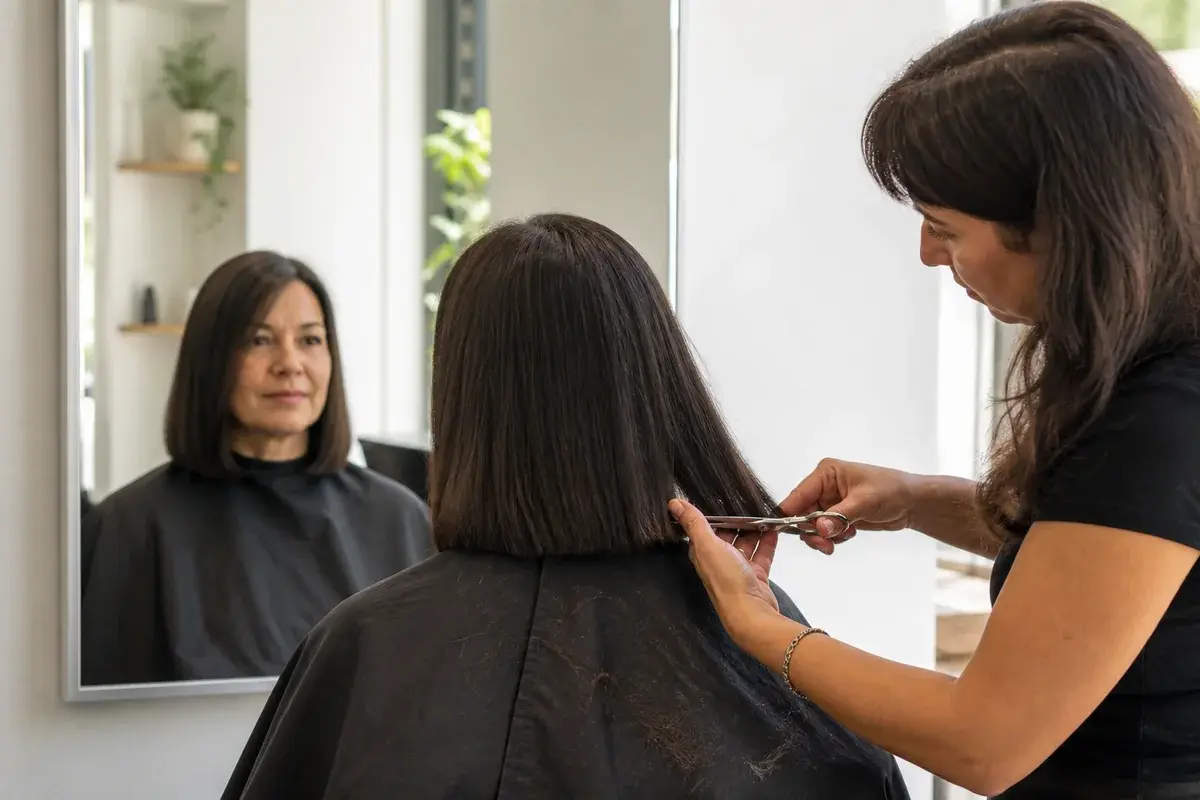
There is no universal six-week rule. A precise pixie, a soft lob, long layers, and a one-length cut lose their intended shapes at different rates. Your preferred finish matters as much as the amount of new growth.
A medically reviewed Healthline guide to haircut timing also organizes intervals by length, layers, texture, and processing. The ranges below are planning anchors, not deadlines.
Step 1: Start with the haircut’s shape
Ask which part of the haircut must stay visually exact. Short perimeters, bangs, and face-framing pieces can move out of position after relatively little growth. A long, lightly shaped perimeter can change more before it looks like a different haircut.
| Haircut feature | Broad planning range | What usually changes first |
|---|---|---|
| Bangs or fringe | About 2–4 weeks | Eye clearance, curve, split, and styling direction |
| Pixie or short precision cut | About 4–6 weeks | Nape, ear area, crown balance, and fringe proportion |
| Precise bob | About 6–8 weeks | Perimeter line, angle, and relationship to the jaw or shoulders |
| Lob, medium layers, or soft shag | About 6–12 weeks | Face framing, layer connection, and shoulder behavior |
| Long layers or long simple perimeter | About 3–6 months | End condition, lower outline, tangling, and layer visibility |
These intervals reflect common maintenance patterns, including ranges discussed in the Healthline guide. Your stylist may recommend something different after seeing the haircut, growth pattern, texture, condition, and goal.
If you intentionally like a softer grow-out, schedule later. If the exact line is the reason you chose the haircut, schedule nearer the earlier end.
Step 2: Decide whether you are maintaining or growing
Use different plans for different goals:
- Maintain the current silhouette: return when new growth changes the defining length, balance, or perimeter.
- Grow while preserving a shape: use longer intervals and ask how the layers or outline can transition without repeatedly returning to the original length.
- Grow with minimal intervention: monitor the ends and handling rather than booking only because a date has arrived.
- Change direction: book a consultation when you need a new shape, even if the current cut is not technically overdue.
Trimming does not change the rate at which hair grows from the scalp. Cleveland Clinic explains that trims can remove splitting ends before damage travels farther along the fiber, but a haircut is not a growth accelerator. See its hair-growth guidance.
Copy this scheduling note:
Current haircut: [shape and length]
My goal: [maintain, grow, or change]
The feature I want to preserve: [fringe, perimeter, layers, nape, or another detail]
The first sign it stops working: [specific sign]
Starting interval: [number of weeks]
Adjustment after the next appointment: [earlier, later, or unchanged]
Step 3: Account for condition, texture, and routine
The calendar cannot show how the ends feel or how a shape behaves during your normal routine. Consider:
- natural pattern and shrinkage
- strand diameter and overall density
- chemical processing and color history
- regular heat styling or mechanical tension
- tangling and ease of detangling
- whether the ends hold the finish you want
- how often the hair is tied, braided, or worn in a protective style
The American Academy of Dermatology’s damage-reduction advice notes that handling and styling habits can contribute to breakage and split ends. That does not mean every damaged-looking end needs the same schedule. It means current handling and condition belong in the consultation.
Curly and coily hair may hide a small amount of growth because of shrinkage, while the layered shape or ends still need attention. Fine strands may show a light or uneven perimeter sooner. High-density hair may retain a strong outline while becoming harder to manage. These are reasons to adapt the range, not assign one interval to an entire hair category.
Step 4: Book by signs, not only by the calendar
Look for repeated, practical changes:
- bangs no longer sit or clear the eyes as intended
- a pixie loses the intended nape, ear, or crown balance
- a bob perimeter no longer reads as the chosen line
- face-framing pieces stop connecting to the rest of the cut
- ends tangle more readily during your normal routine
- the lower outline looks uneven or substantially lighter than you want
- styling consistently takes more effort because the cut has lost its structure
One difficult hair day is not a scheduling system. Notice whether the issue persists across washes and normal styling. If the cut still works well when worn naturally, you may be able to extend the interval.
Record the date and the first meaningful change after two appointments. That gives you a personal interval based on the actual cut instead of a generic reminder.
Common haircut-scheduling mistakes
Following one interval for every haircut
A fringe and a long one-length perimeter do not show growth in the same way. Schedule around the defining feature.
Trimming frequently to make hair grow faster
Cutting the fiber does not affect follicle growth. The useful reason to trim while growing is to manage the shape and ends. To see how much time your trim schedule adds to a grow-out, try the hair growth calculator.
Waiting for severe splitting or tangling
Use earlier signs such as a perimeter losing clarity or ends becoming consistently harder to handle.
Ignoring the intended grow-out
Some cuts are designed to soften into a longer version. Ask your stylist which areas can grow and which details will need adjustment.
Treating breakage or hair loss as a haircut problem
A trim can change the appearance of the ends, but it cannot diagnose or treat sudden shedding, patchiness, or scalp symptoms. Consult a qualified healthcare professional about those changes.
Preview your next length with Hair Fairy
Before choosing whether to maintain or grow, compare a few lengths through the women’s hairstyle directory or Hair Fairy Custom Style. For example, compare a pixie cut, blunt bob, and shoulder-length lob while keeping the same portrait and color.
The preview can clarify your length preference, but it cannot predict growth rate, end condition, breakage, or the ideal appointment date. Use the low-maintenance haircut comparison if reducing either daily styling or salon upkeep is the larger goal.
Decision summary
Start with a range based on the haircut’s defining feature, then adjust it according to whether you are maintaining or growing, how the hair behaves, and when the shape consistently stops working. Your best interval is the one supported by observable signs and a clear goal.
Frequently Asked Questions
Questions about choosing and maintaining a haircut
How often should women get a haircut?
The interval varies by haircut and goal. Bangs or short precision areas may need attention in two to six weeks, medium cuts often in six to twelve weeks, and long simple shapes roughly every three to six months.
How often should I trim my hair if I am growing it?
Use a longer interval and ask for a minimal maintenance trim when the ends become difficult, the perimeter loses its shape, or breakage affects the length. Cutting more frequently does not accelerate growth from the scalp.
How often does a pixie cut need trimming?
A pixie often shows changes around the ears, nape, fringe, and crown within about four to six weeks, although a softer shape may be intentionally grown for longer.
How often should a bob or lob be cut?
A precise bob may need attention around six to eight weeks, while a softer lob may remain workable for eight to twelve weeks. Texture, perimeter, and desired finish change the interval.
Do curly or coily haircuts need fewer trims?
Not automatically. Growth may be less visually obvious because of shrinkage, but shape, tangling, ends, density, and styling goals still determine when a trim is useful.
Does trimming hair make it grow faster?
No. Cutting affects the fiber beyond the scalp, not the rate of growth at the follicle. Trimming can remove damaged or splitting ends and help preserve a cleaner perimeter.
About This Guide
Hair Fairy EditorialEditorial team, Hair Fairy
Hair Fairy Editorial writes and reviews Hair Fairy guides with a focus on realistic haircut decisions, clear salon communication, and styles that work beyond the inspiration photo. The team balances visual ideas with texture, maintenance, and everyday wear.
Women’s haircut selection, face-shape and texture considerations, salon-reference planning, maintenance trade-offs, clear stylist communication, and responsible use of AI hairstyle previews as decision aids rather than guarantees.
View author profileSee us more often in Google
One click marks Hair Fairy as a preferred source, so our articles are more likely to appear in your Top Stories, and can show a preferred badge in AI Mode and AI Overviews.
Compare Your Idea
Preview a hairstyle on your own photo.
Use a reference, a written description, or both—then discuss the practical result with your stylist.