
Face Shape Guides
How to Determine Your Face Shape for a Haircut: 4 Steps
Use a straight-on photo, compare facial proportions, check the jaw and hairline, and turn your face shape into flexible haircut guidance.
 Hair Fairy Editorial7 min read
To determine your face shape for a haircut, take a straight-on photo with your hair pulled away, compare the visible length and the widths of your forehead, cheekbones, and jaw, then check whether your jaw and chin look rounded, angular, or tapered. Use the closest shape as a descriptive starting point, not a rule about which haircuts you can wear.
Key Takeaways
- Use a neutral, straight-on view because camera angle, expression, hair volume, and perspective can change the outline you see.
- Compare several proportions together; one feature, such as a pointed chin or broad forehead, does not determine the whole face shape.
- Many faces sit between categories, and haircut choices should also account for hair texture, density, routine, and personal preference.
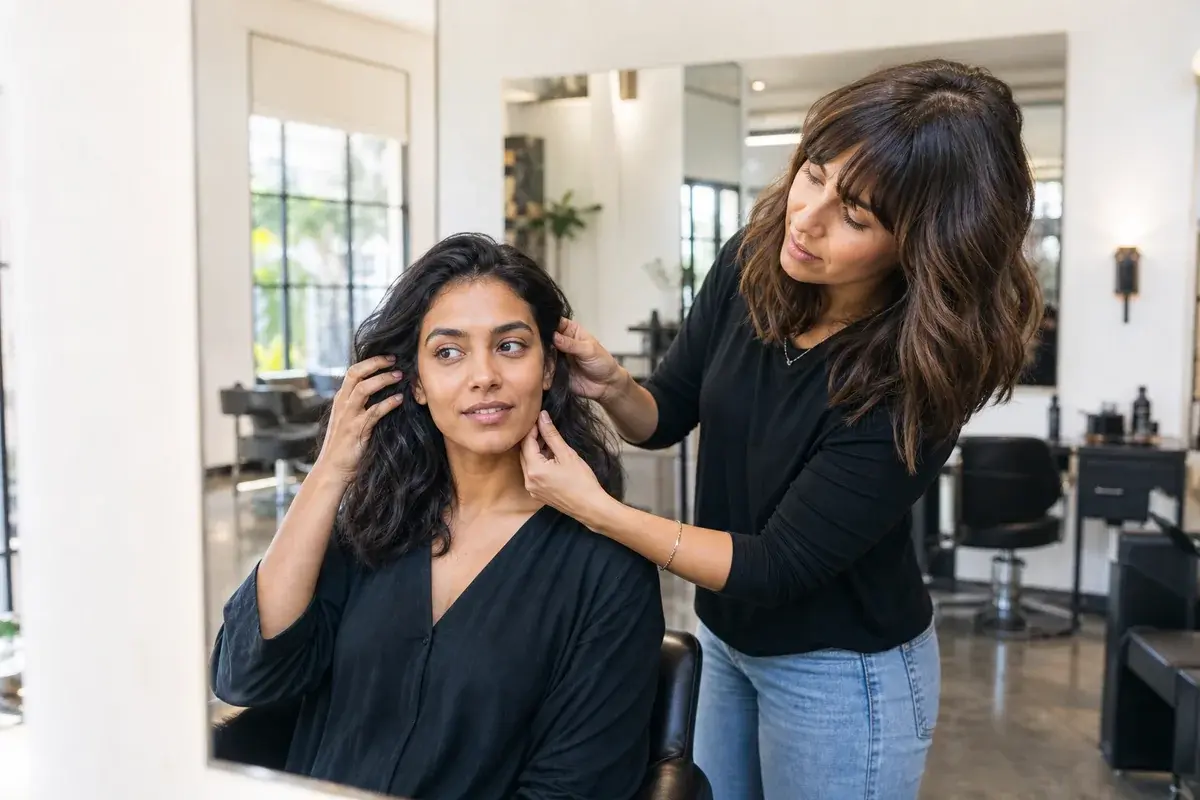
Face-shape categories are shorthand for visible proportions. They can help you discuss where a haircut places length, width, movement, and volume, but they do not measure attractiveness or determine what you are allowed to wear.
Hair.com’s professional face-shape guide also recommends considering hair thickness and texture rather than looking at facial outline in isolation. This guide goes one step earlier: it helps you describe the outline before you build a haircut shortlist.
Step 1: Take a neutral, straight-on photo
Stand or sit upright and place the camera at eye level. Use a little distance rather than holding a wide-angle phone camera very close to your face. Look forward with a relaxed expression and even light on both sides.
Pull the hair away from the forehead, temples, cheeks, and jaw. Avoid using a photo with lifted roots, heavy side volume, bangs, a tilted head, or a dramatic smile because each can alter the apparent outline.
Use this photo checklist:
- camera at eye level and centered
- face looking straight ahead
- relaxed expression
- hairline, temples, cheek area, and jaw visible
- even light without a strong side shadow
- enough distance to avoid obvious lens distortion
If you want a second view, take it in the same place and lighting. A mirror can help you observe, but a still photo makes side-to-side comparisons easier.
Step 2: Compare length and width
Look at four broad dimensions: total visible face length, forehead width, cheekbone width, and jaw width. You do not need a perfect measurement in millimeters. You are looking for the relationship among them.
| Common label | Typical visible pattern | Useful question for a haircut |
|---|---|---|
| Oval | Face appears longer than wide, with gently balanced widths | Do you want to preserve the balance or create stronger width or angles? |
| Round | Length and width appear relatively close, with softer outer lines | Where would you like vertical movement, asymmetry, or visible width? |
| Square | Forehead, cheek, and jaw widths appear related, with a more angular jaw | Do you want to echo the geometry or contrast it with softer movement? |
| Heart | Forehead appears broader and the lower face tapers toward the chin | Would you like more openness near the forehead or more weight near the jaw? |
| Diamond | Cheekbones appear widest while forehead and jaw look narrower | Do you want to emphasize the cheek area or redistribute width above or below it? |
| Oblong | Face appears distinctly longer than wide, often with related forehead and jaw widths | Where would you like width, fringe, or horizontal movement? |
These descriptions overlap. A face can appear oval with a square jaw, round with a tapered chin, or heart-shaped with prominent cheekbones. Record the combination instead of forcing a single label.
Step 3: Check the jaw, chin, and hairline
Use the outer features to refine your first comparison:
- Jaw: Does it curve gradually, form a straighter angle, or narrow visibly toward the chin?
- Chin: Does it look rounded, flat, pointed, or softly tapered in the neutral photo?
- Hairline and forehead: Does the visible upper face look broad, narrow, rounded, or affected by a widow’s peak?
- Cheekbones: Do they form the widest visible point, or are the forehead and jaw similarly wide?
Do not let one feature override everything else. A pointed chin does not automatically mean heart-shaped, and a defined jaw does not automatically mean square. The relationship among all four areas is more useful.
If your outline has changed suddenly, or if you are concerned about swelling, asymmetry, or another health change, a haircut guide is not a diagnostic tool. Speak with an appropriate healthcare professional.
Step 4: Turn the shape into a haircut brief
Replace “What is the best haircut for this face shape?” with “What do I want the haircut to emphasize?” You may want to reveal the jaw, bring movement toward the cheekbones, keep the forehead open, add a side direction, or create a strong perimeter.
Copy this brief:
My closest face-shape description: [one category or combination]
The proportions I notice: [length, width, jaw, chin, hairline]
I want to emphasize: [feature or overall effect]
I prefer volume around: [crown, temples, cheeks, jaw, or lengths]
I want to avoid: [a placement or effect you personally dislike]
My hair and routine: [texture, density, part, and normal styling]
Then use the women’s hairstyle directory to build two or three candidates. A shoulder-length lob, long layers, curly shag, and pixie cut can each be adapted through length, parting, fringe, and volume placement.
For a broader decision process that includes routine and commitment, use the four-check haircut suitability guide. If round is your closest description, the round-face haircut comparison gives seven options without framing the goal as hiding or correcting your face.
Common face-shape mistakes
Using a selfie taken too close
Close camera perspective can exaggerate the center of the face and change the apparent relationship among the forehead, cheekbones, and jaw.
Tracing around the hair instead of the face
Hair volume is part of a hairstyle silhouette, but it should not become part of the facial outline you are trying to describe.
Treating measurements as perfectly objective
Hairline boundaries, camera angle, expression, and landmark placement introduce uncertainty. Use measurements as comparison aids rather than a scientific classification.
Assuming one shape has one correct haircut
The same cut can be adjusted through length, layers, fringe, parting, texture, and finish. Personal emphasis matters more than a rigid matching chart.
Ignoring natural hair behavior
Face shape cannot tell you how curls shrink, where dense hair holds weight, or whether a fringe will cooperate with a cowlick. Include those realities in the final brief.
Compare haircut directions with Hair Fairy
After you have two or three candidates, use Hair Fairy to compare their visible silhouettes on one portrait. Keep the same source image and change one feature at a time so face, angle, and lighting remain comparable.
Hair Fairy does not identify face shape or decide which style is most suitable. A preview cannot predict natural movement or salon execution; use it to clarify your preference before discussing adaptation with a hairstylist.
Decision summary
Use a neutral photo, compare several proportions, and describe any overlap honestly. Then translate the label into the feature and volume placement you want. The useful outcome is not a perfect category—it is a clearer haircut brief.
Frequently Asked Questions
Questions about face shape and haircut choices
How do I determine my face shape?
Pull your hair away from your face, take a straight-on photo at eye level, and compare face length with the visible widths of your forehead, cheekbones, and jaw. Then note whether the jaw and chin look rounded, angular, or tapered.
What if my face matches more than one shape?
That is common. Use two nearby categories to describe your proportions, then focus on the specific features and volume placement you want the haircut to emphasize.
Do I need exact measurements to find my face shape?
No. Measurements can organize the comparison, but small differences are easily affected by camera perspective, hairline interpretation, and where you place the measuring points.
Can my face shape change over time?
Bone structure is only part of the visible outline. Hairstyle, weight changes, aging, facial hair, camera angle, and expression can all change how the proportions appear.
Does face shape determine which haircut will suit me?
No. Face shape is one input alongside texture, density, growth patterns, routine, desired emphasis, and personal taste. It should help you compare options rather than eliminate them automatically.
Can Hair Fairy identify my face shape?
No. Hair Fairy previews hairstyle directions on a portrait, but it does not measure, classify, or diagnose face shape and does not select an objectively best haircut.
About This Guide
Hair Fairy EditorialEditorial team, Hair Fairy
Hair Fairy Editorial writes and reviews Hair Fairy guides with a focus on realistic haircut decisions, clear salon communication, and styles that work beyond the inspiration photo. The team balances visual ideas with texture, maintenance, and everyday wear.
Women’s haircut selection, face-shape and texture considerations, salon-reference planning, maintenance trade-offs, clear stylist communication, and responsible use of AI hairstyle previews as decision aids rather than guarantees.
View author profileSee us more often in Google
One click marks Hair Fairy as a preferred source, so our articles are more likely to appear in your Top Stories, and can show a preferred badge in AI Mode and AI Overviews.
Compare Your Idea
Preview a hairstyle on your own photo.
Use a reference, a written description, or both—then discuss the practical result with your stylist.