
Salon Planning
How to Prepare for a Curly Haircut Appointment: 4 Steps
Confirm salon preparation instructions, document your everyday curls, and bring a dry-length brief for a useful curly haircut consultation.
Prepare for a curly haircut appointment by asking the salon how to arrive, documenting your normal dry curl pattern, choosing references and a minimum dry length, and confirming the consultation plan before cutting. Follow the salon’s specific wash, product, and detangling instructions rather than assuming every curly service needs identical preparation.
Key Takeaways
- Ask the salon about washing, products, detangling, and arrival style before changing your usual routine.
- Bring ordinary dry-hair photos that show the front, sides, and back, including areas with different curl behavior.
- Agree a dry endpoint, routine, and final shape check instead of selecting a cutting method by name alone.
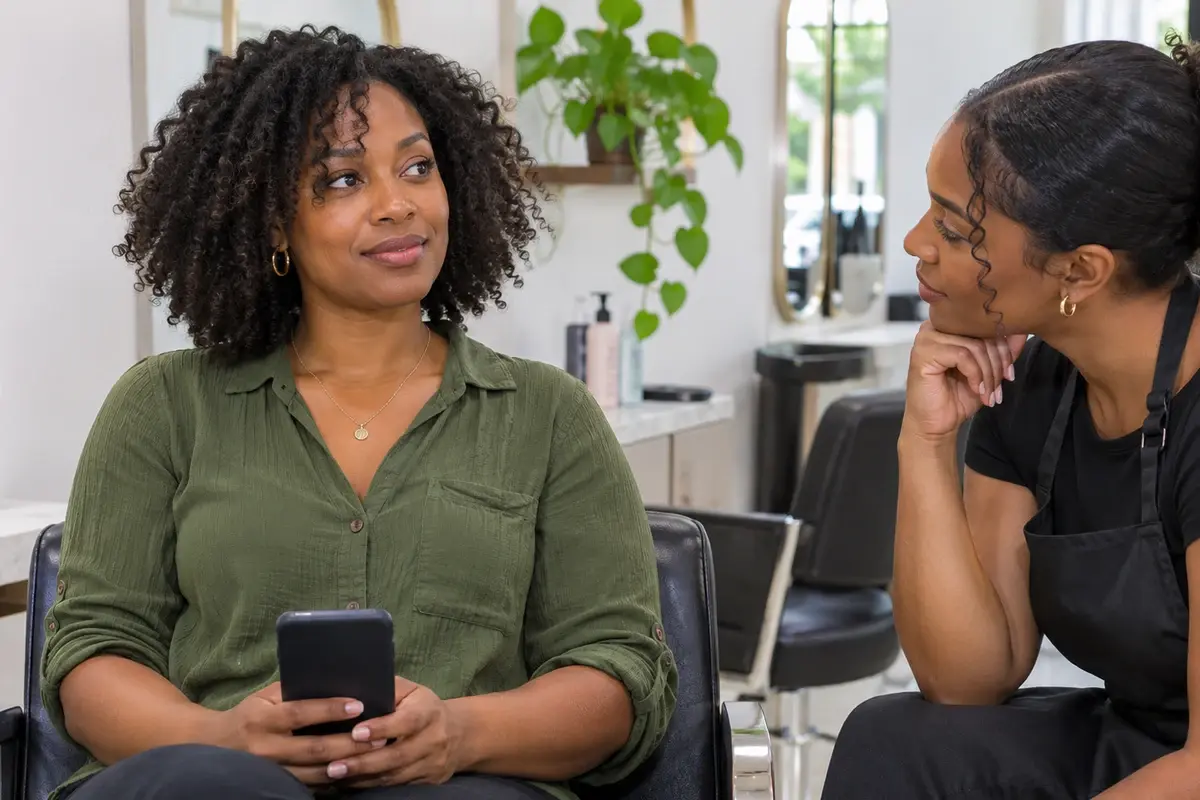
Step 1: Ask the salon how to arrive
Contact the salon before wash day. Ask whether this appointment includes washing, whether they want your hair dry or damp on arrival, which products to use or avoid, and how they want it detangled. Tell them about braids, twists, extensions, straightening, or any service that changes what they will see.
Do not arrive with painfully tangled hair because you read that curls should never be disturbed, or straighten it because you assume a stylist needs a smooth canvas. Different services can have different preparation needs. If the instructions conflict with your usual care or accessibility needs, ask for an alternative and clarify appointment time.
The British Association of Dermatologists recommends careful detangling and gentle drying for Afro-textured hair. Its guidance does not prescribe a universal haircut arrival routine. Let the salon explain its service while protecting comfortable handling. Your output is a confirmed arrival plan: wash timing, permitted products, detangling method, and arrival style.
Step 2: Document your everyday dry curls
Take front, side, and rear photos on an ordinary hair day before your appointment. Include the crown and nape if those sections behave differently. Record how you dried the hair and whether you stretched, brushed, diffused, or tied it while drying. Save a second day if your shape changes noticeably after sleep.
The goal is to show the result you live with, not your most polished photograph. Note areas that sit shorter, appear denser, separate into smaller groups, or project farther from the head. Treat these as observations rather than measurements of a fixed curl category.
The AAD distinguishes gentle damp combing for textured hair or tight curls from its advice for straight hair. Avoid repeatedly dry-brushing just to create a preparation photograph. Use your existing routine and ask the salon how to handle tangles. Record the normal routine using the air-drying haircut worksheet if that is your regular finish.
Step 3: Choose a shape and a minimum dry length
Bring two or three references with a similar visible texture and enough angles to explain the outline. Select one feature from each: the side volume, rounded back, face exposure, or perimeter. The reference-photo guide helps separate those details from color and professional finishing.
Point to the shortest acceptable dry endpoint around your face and at the back. Explain whether you usually wear the hair loose, stretched, or tied. Avoid converting a wet measurement to a dry target with an assumed percentage; your own pattern variation is the relevant discussion.
| Bring | Label it with | Decision it supports |
|---|---|---|
| Ordinary front photo | Drying method and part | Face exposure and front length |
| Side and back photos | Areas that sit differently | Overall outline and balance |
| Two references | One wanted feature in each | Shape rather than exact duplication |
| Length note | Shortest dry point you accept | Boundary before cutting |
Use the curly haircut comparison to shortlist shapes, not to insist on a specific cutting technique. Your output is two shape references and a written dry-length boundary.
Step 4: Confirm the consultation and finish check
Before the service, explain what to preserve, what to change, and how much styling you will actually do. Tell the stylist about chemical services and heat use that may affect the lengths. Ask how they will account for different patterns and where you will check the shape together.
Copy this brief: “I normally wear my hair [routine]. These photos show [ordinary behavior]. I want [outline], while keeping [feature]. My shortest comfortable dry point is [landmark]. I do not want to add [daily task]. How will you adapt the plan to pattern variation, condition, and shrinkage, and how will we check the finished shape?”
A dry cut is not a universal promise of a more suitable result, and a wet cut is not automatically inappropriate. Ask why the proposed approach supports your desired outcome. The stylist should select the technique and explain the tradeoff. If pain, patchiness, sudden shedding, or scalp symptoms are present, seek appropriate healthcare advice and tell the salon before the appointment. Your output is a shared plan and a point at which to review it.
Common mistakes
Following a generic “no product” instruction without checking the salon can conflict with the booked service. Arriving with only a stretched-length target leaves the dry outcome unclear. Choosing a reference solely by curl label misses density, layers, and styling. Asking the stylist to recreate a preview exactly can conceal the adaptation your actual hair needs.
Compare outlines with Hair Fairy
After completing the independent plan, use Hair Fairy Custom Style with a reference image, a written description, or both. Compare two agreed outlines using the same portrait, curl direction, color, and part. Reject results that straighten your curls, invent substantially denser hair, or change your face. Save only valid visual references and label the preferred perimeter and volume; a front image cannot confirm the back shape. A preview cannot measure your hair, predict natural behavior, select cutting technique, confirm feasibility, or guarantee a salon result. Review the photo privacy policy before uploading. Take your finalists and remaining questions to a hairstylist.
Decision summary
Prepare for a curly appointment with salon-specific arrival instructions, ordinary dry-hair photos, a shape shortlist and dry-length boundary, and a confirmed finish check. Bring the information that helps your stylist adapt the cut rather than trying to prescribe the technique.
Frequently Asked Questions
Questions about planning your haircut
Should I wash my curls before the appointment?
Ask the salon how recently to wash and whether washing is included. The useful answer depends on the booked service and its arrival instructions.
Should I arrive with no products?
Confirm with the salon. Describe what you normally use and ask which products they want included or omitted for this service.
Should I detangle before a curly haircut?
Ask how the salon wants it done and explain any difficulties. Handle the hair gently; do not force through painful tangles to meet an assumed rule.
Do all curly haircuts need to be dry cuts?
No single cutting method defines every curly service. Ask the stylist how the chosen approach accounts for your dry shape, routine, and pattern variation.
What photos should I bring?
Bring ordinary dry front, side, and back views plus two or three labeled shape references. Say how each photo was styled.
Can a preview predict shrinkage after the cut?
No. It can illustrate a preferred outline, but cannot measure shrinkage, natural movement, or the finished salon result.
About This Guide
Diane BennettBlog author, Hair Fairy
Diane Bennett writes Hair Fairy guides about haircut decisions, everyday hair routines, and preparing clear questions for a hairstylist.
Haircut comparison, salon planning, and responsible use of visual hairstyle previews.
View author profileSee us more often in Google
One click marks Hair Fairy as a preferred source, so our articles are more likely to appear in your Top Stories, and can show a preferred badge in AI Mode and AI Overviews.
Compare Your Idea
Preview a hairstyle on your own photo.
Use a reference, a written description, or both—then discuss the practical result with your stylist.