
Hair Type Guides
7 Best Haircuts for Cowlicks, From Cropped to Long
Compare seven cowlick-aware haircuts by growth direction, location, length, texture, styling routine, and maintenance.
 Diane Bennett9 min read
A long textured pixie is the strongest overall haircut for cowlicks because its adjustable top and fringe can either follow a strong growth direction or keep enough length to redirect it. A side-swept crop, layered bob, shoulder-length lob, curly shag, long blended layers, or tailored blunt bob may work better depending on whether the cowlick sits at the front hairline, crown, part, or nape and how much daily styling you accept.
Key Takeaways
- Map the cowlick on clean, dry hair before choosing a cut; its location, direction, and behavior at different lengths matter more than the label.
- The practical choice is usually to follow the growth direction, leave enough weight to redirect it, or cut short enough to make the lift intentional.
- A haircut can manage the visible result but does not change the follicle’s natural growth direction.
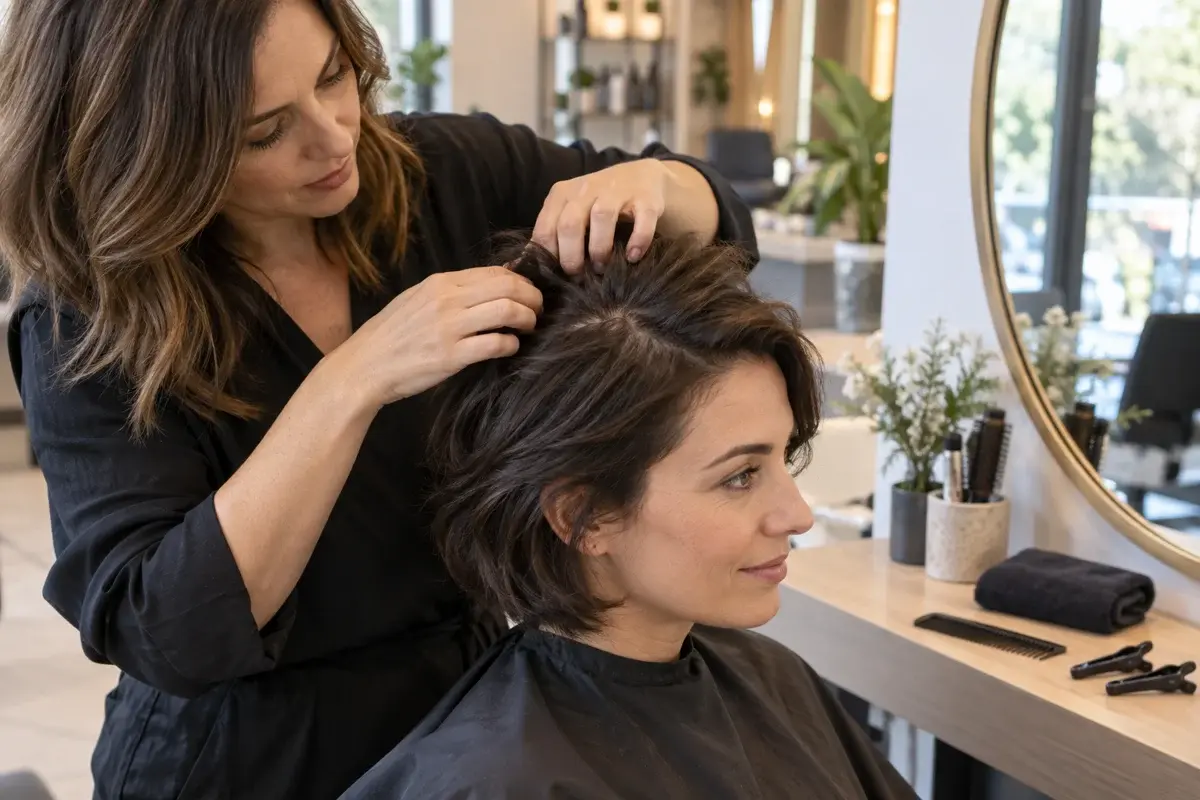
A cowlick is a section that grows in a distinct direction from the surrounding hair; at the crown it may form part of a visible whorl. It is a growth pattern, not damage or a defect. The useful haircut either works with that direction, retains enough length to redirect it, or makes its lift part of the intended shape.
Map the cowlick before you rank the cuts
Look at clean, dry hair in its normal finish. Photograph the front, both sides, crown, and nape. Mark whether the pattern:
- lifts at the front hairline
- separates a fringe or part
- spirals or splits at the crown
- pushes away from the head near a temple
- reverses direction at the nape
- changes when the section is shorter, longer, damp, or slept on
Standard morphology terminology describes a scalp whorl as hair arranged around a point and a frontal cowlick as an upward and sideward growth pattern (American Journal of Medical Genetics). This supports the practical point: direction is anchored in follicle orientation, so cutting changes the visible response, not the underlying growth.
Sudden patchiness, shedding, scalp pain, or a new area of breakage is not a haircut-selection question. Discuss those changes with an appropriate healthcare professional.
How we ranked the options
This ranking favors cuts with more than one way to accommodate a strong growth pattern. The criteria are:
- ability to follow or redirect the natural direction
- useful length choices around the front, crown, and nape
- tolerance for separation, lift, and day-to-day variation
- adaptability across texture, density, and strand diameter
- realistic styling and salon-upkeep demands
- clarity of the adaptation a hairstylist needs to make
No haircut controls every cowlick. Location and the length at which the section becomes manageable can change the order for you.
Comparison at a glance
| Rank | Haircut | Main benefit | Main tradeoff |
|---|---|---|---|
| 1 | Long textured pixie | Multiple directions through top and fringe | Crown and sleep movement stay visible |
| 2 | Side-swept crop | Can follow a front cowlick naturally | Opposite-direction styling may be difficult |
| 3 | Layered bob | Movement can absorb crown variation | Short crown layers may spring up too much |
| 4 | Shoulder-length lob | More weight and broad part flexibility | Shoulder contact can add another bend |
| 5 | Curly or wavy shag | Irregular lift fits a textured outline | Layer placement needs texture-aware planning |
| 6 | Long blended layers | Length may help redirect sections | Crown separation can still show |
| 7 | Tailored blunt bob | Strong perimeter can anchor the shape | Solid geometry may expose an unplanned split |
1. Long textured pixie
Who it suits: Someone ready for a short cut who wants choices through the top, crown, and fringe.
Why it ranks: A long pixie can retain enough top length to sweep with the growth while shorter surrounding sections make lift feel intentional.
Main benefit: The design can switch between separated, swept, and softly lifted finishes.
Limitation: Crown movement, sleep flattening, and growth around the ears and nape remain visible.
How to adapt it: Ask the hairstylist to examine the hair dry, then define which sections should follow the cowlick and which need enough length to cross it.
2. Side-swept crop
Who it suits: Someone with a strong front or temple direction that already favors one side.
Why it ranks: A side-swept crop turns the established direction into the main front line instead of forcing a centered or opposite part.
Main benefit: The cowlick can initiate the sweep.
Limitation: Changing sides or wearing a straight-down fringe may take more effort.
How to adapt it: Establish the natural split, the shortest front point, and how much forehead and temple you want visible.
3. Layered bob
Who it suits: Someone who wants a compact cut with more movement than a solid bob.
Why it ranks: A layered bob can give the crown and sides enough variation that a small lift or separation does not interrupt an otherwise rigid line.
Main benefit: It balances a readable bob outline with flexible internal movement.
Limitation: Layers cut too short over a strong crown whorl may stand higher than intended.
How to adapt it: Preserve length directly over the whorl until the hairstylist has tested how the section falls.
4. Shoulder-length lob
Who it suits: Someone who wants enough length for weight, tucking, and tying while keeping a defined perimeter.
Why it ranks: A shoulder-length lob can allow a front or crown section to reach across its natural split without committing to long hair.
Main benefit: It offers several part positions and practical styling options.
Limitation: Extra length does not guarantee control, and the shoulders may turn the ends.
How to adapt it: Test the usual and alternative parts on dry hair, and decide whether face framing should begin above or below the cowlick-affected zone.
5. Curly or wavy shag
Who it suits: Someone whose natural texture already includes varied direction and volume.
Why it ranks: A curly shag can treat crown lift as part of a deliberately layered, textured silhouette.
Main benefit: A single irregular section is less likely to look accidental within broader movement.
Limitation: Shrinkage, density, curl variation, and short crown layers can amplify height.
How to adapt it: Agree on the dry crown height, shortest layer, and fringe behavior rather than copying a wet or stretched reference.
6. Long blended layers
Who it suits: Someone who prefers long hair and wants weight available for redirection.
Why it ranks: Long layers can keep the cowlick area relatively long while adding movement below it.
Main benefit: The affected section is not automatically cut into a short, springing layer.
Limitation: A crown split may remain visible, especially when density is lower or hair is oily.
How to adapt it: Keep the shortest layer below the most reactive zone unless the goal is to reveal more lift.
7. Tailored blunt bob
Who it suits: Someone who wants a strong perimeter and whose cowlick can be accommodated through part, length, or nape adjustment.
Why it ranks: A blunt bob provides enough lower weight to anchor the overall silhouette even when the top has directional variation.
Main benefit: The perimeter gives the haircut a clear visual structure.
Limitation: A rigid center part or overly short nape may fight the specific growth pattern.
How to adapt it: Let the natural part sit slightly off center, preserve weight where needed, and set the nape only after checking how it grows.
Choose your cowlick-aware finalists
| Cowlick location or priority | Start with | Compare against | Ask in consultation |
|---|---|---|---|
| Front hairline lift | Side-swept crop | Long pixie | Follow the lift or leave redirecting length? |
| Crown whorl | Long pixie | Layered bob | Which layer length avoids unwanted spring? |
| Strong part separation | Shoulder lob | Long layers | Which parts remain realistic when dry? |
| Textured crown movement | Curly or wavy shag | Layered bob | Where should dry crown height end? |
| Nape reversal | Tailored bob | Long pixie | Cover, expose, or incorporate the nape direction? |
Take photos of your hair on an ordinary air-dried day and after your usual styling. Add them to two or three haircut references using the reference-photo guide. The strand-and-density guide can help you describe the rest of the hair separately from the cowlick.
Compare overall shapes with Hair Fairy
Once you know which directions are technically plausible, compare a long pixie, layered bob, and shoulder-length lob on the same portrait. Hold color, camera angle, and unrelated styling constant. Use Custom Style to describe the intended part and visible crown shape.
Reject any result that erases or invents a hairline, changes the face, or ignores the requested texture. A generated preview cannot see the real whorl, test damp-to-dry resistance, choose sectioning, or prove that the hairstyle will sit as shown. Bring the comparison to a hairstylist as a visual question, not a prediction.
The American Academy of Dermatology recommends limiting excessive heat and using low or medium settings when heat is needed (AAD). If a finalist requires forceful daily heat control to oppose the cowlick, include that demand in your decision.
Direct recommendation
Start with a long textured pixie when you want a short, adaptable shape that can cooperate with front or crown direction. Choose a side-swept crop for a front cowlick, a lob or long layers when weight and part flexibility matter, or a textured shag when variable lift belongs in the design. The most reliable plan begins with a dry growth-pattern check by the hairstylist who will adapt the cut.
Frequently Asked Questions
Questions about hair type and haircut choices
What haircut is best for a cowlick?
A long textured pixie is a versatile starting point because the top can follow the growth direction or retain enough length for controlled placement. The best adaptation depends on where the cowlick sits, your texture, density, routine, and preferred shape.
Should hair around a cowlick be cut short or left long?
Either can work. Very short hair can turn lift into deliberate texture, while longer hair may provide enough weight and reach to redirect the section. The difficult zone is often an in-between length, which should be tested with a hairstylist.
Can bangs work with a front cowlick?
Yes, but the opening, direction, dry length, and styling expectation need adjustment. Side-swept or curtain shapes may cooperate with natural separation, while a solid fringe may require more daily control.
What haircut works for a crown cowlick?
Textured pixies, layered bobs, shags, and longer layered cuts can incorporate crown direction in different ways. Ask the hairstylist to inspect the crown dry and explain whether the plan follows, weights, or exposes the whorl.
Can a haircut remove a cowlick permanently?
No. Cutting can change length, weight, and visible shape, but it does not alter the follicle growth direction that creates the cowlick or whorl.
Can an AI preview show how a cowlick will behave after a haircut?
No. A preview can compare general silhouettes, but it cannot inspect follicle direction, resistance, damp-to-dry behavior, cutting technique, or the finished salon result.
About This Guide
Diane BennettWomen’s Hairstyle Editor, Hair Fairy
Diane writes and reviews Hair Fairy guides with a focus on realistic haircut decisions, clear salon communication, and styles that work beyond the inspiration photo. Her approach balances visual ideas with texture, maintenance, and everyday wear.
Women’s haircut selection, face-shape and texture considerations, salon-reference planning, maintenance trade-offs, clear stylist communication, and responsible use of AI hairstyle previews as decision aids rather than guarantees.
View author profileSee us more often in Google
One click marks Hair Fairy as a preferred source, so our articles are more likely to appear in your Top Stories, and can show a preferred badge in AI Mode and AI Overviews.
Compare Your Idea
Preview a hairstyle on your own photo.
Use a reference, a written description, or both—then discuss the practical result with your stylist.