
Hair Type Guides
How to Tell If You Have Fine, Medium, or Coarse Hair: 4 Checks
Separate strand diameter from density, inspect several dry strands, estimate overall density, and record the combination for better haircut decisions.
 Hair Fairy Editorial7 min read
To tell whether your strands are fine, medium, or coarse, first separate strand diameter from overall density, then inspect several clean, dry shed strands from different areas and note how visible and substantial they feel. Estimate density separately by observing how readily the scalp shows through consistent sections. Your result may be a combination, such as fine strands with high density.
Key Takeaways
- Fine, medium, and coarse describe the diameter of individual strands; low, medium, and high density describe how much hair grows across an area.
- Curl pattern does not determine strand diameter, so straight hair can be coarse and curly or coily hair can be fine.
- Home checks provide a practical estimate, not a medical assessment, and mixed strand diameters across the scalp are possible.
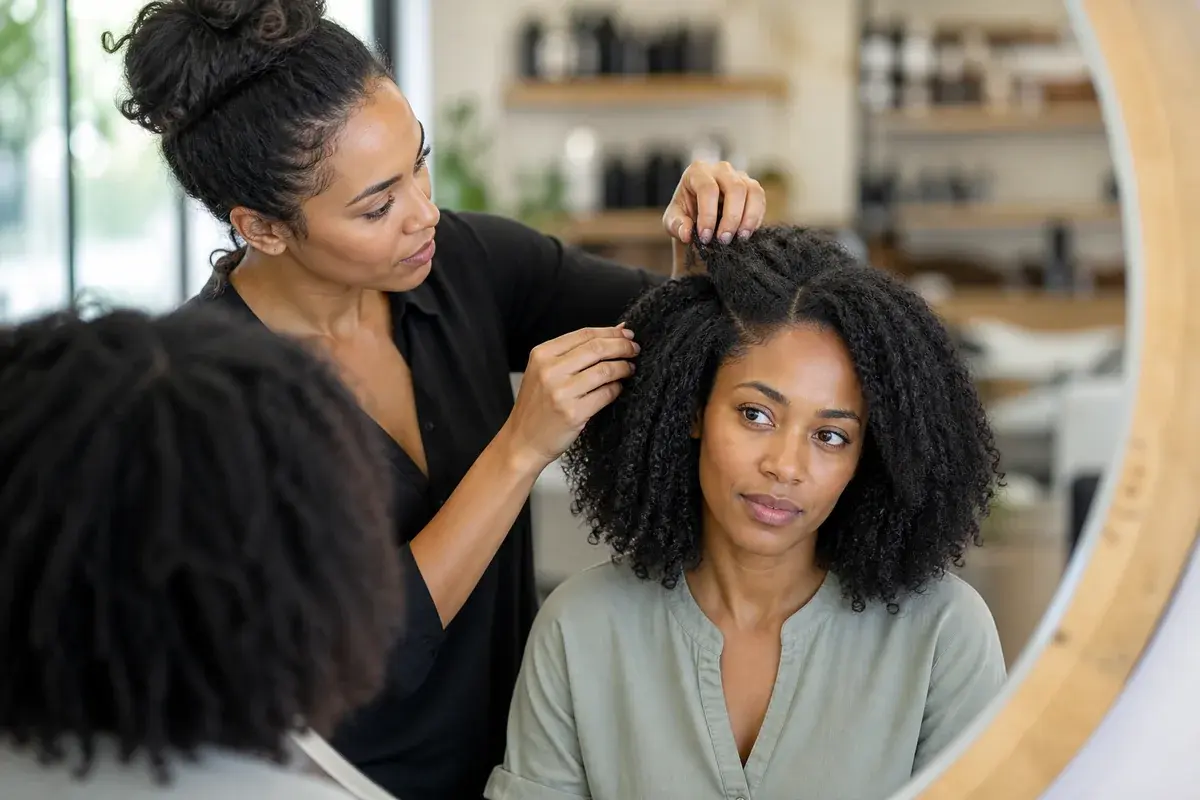
“Thick hair” can mean two different things: large individual strands or a large amount of hair. Separating those ideas makes haircut and styling conversations much clearer.
Clinical work can measure strand diameter with specialized imaging, and JAMA Dermatology research has used measured ranges to score thin, medium, and thick diameters. At home, the realistic goal is a broad category rather than a precise micron measurement.
Step 1: Separate strand diameter from density
Strand diameter and density describe different dimensions:
| Characteristic | What it describes | Useful home observation | What it can affect in a haircut |
|---|---|---|---|
| Fine, medium, or coarse | Width of an individual hair fiber | Visibility and feel of several clean, dry strands | Perimeter weight, delicacy, and response to extensive layering |
| Low, medium, or high density | Number of strands across an area of scalp | How readily the scalp shows through comparable sections | Overall bulk, weight distribution, and visual fullness |
| Straight, wavy, curly, or coily pattern | Shape the fibers form | Natural pattern after your normal drying method | Shrinkage, movement, silhouette, and styling method |
| Condition and porosity | Current state and how hair takes in and loses moisture | Tangling, roughness, elasticity, and processing history | Handling, finish, and how much change is sensible now |
Healthline’s medically reviewed density guide defines density as the number of strands in a given scalp area and notes that a visual check can provide a general home estimate. It also cautions that ponytail circumference is influenced by individual strand thickness, which is why one measurement cannot separate the two dimensions.
Step 2: Inspect several clean, dry strands
Use strands that shed naturally during washing or brushing rather than pulling hair from the scalp. Let them dry without a coating of styling product. Collect several from different areas because diameter can vary.
Place each strand on a contrasting plain surface and observe it in ordinary light:
- Likely fine: difficult to see or feel individually, with a very slight fiber
- Likely medium: visible and perceptible without feeling especially slight or substantial
- Likely coarse: clearly visible and more substantial as an individual fiber
These are relative observations, not universal measurements. Sewing thread is not a dependable standard because threads vary in fiber and diameter. Rolling one hair between the fingers is also subjective, so combine touch with visibility and use several strands.
Do not infer diameter from curl pattern. Current fine-versus-coarse guidance from Carol’s Daughter likewise separates strand width from curl pattern and density.
Step 3: Estimate density separately
Start with dry hair in its usual state, without a tight style compressing it. In consistent light, create similar-sized parts at the front, sides, crown, and back where practical. Notice how readily the scalp is visible without stretching the part wider.
A broad working estimate is enough:
- Lower density: scalp is relatively easy to see through ordinary sections.
- Medium density: scalp appears clearly at the part but less through the surrounding hair.
- Higher density: scalp is harder to see except along a deliberately opened part.
Color contrast between hair and scalp, curl volume, part width, lighting, and styling can change the appearance. A ponytail measurement also combines strand diameter, density, compression, and length, so do not treat it as a precise test.
If you notice sudden shedding, patchiness, a widening part, scalp symptoms, or a meaningful change from your normal density, an at-home category is not a diagnosis. The American Academy of Dermatology recommends consulting a board-certified dermatologist about hair loss concerns.
Step 4: Record the combination for your haircut
Write the result as a combination instead of reducing your hair to one word:
Pattern: [straight, wavy, curly, coily, or mixed]
Strand diameter: [mostly fine, medium, coarse, or mixed]
Density: [lower, medium, or higher]
Growth behavior: [cowlicks, shrinkage, strong part, or other observation]
Current condition: [unprocessed, color-treated, heat-styled, fragile ends, or another relevant detail]
Normal routine: [air-dry, diffuse, blow-dry, straighten, tie back, or another routine]
Use the record to ask better questions. Fine strands with high density may support a completely different silhouette from fine strands with lower density. Coarse strands with lower density do not automatically behave like high-density hair.
The best haircuts for fine hair compares perimeter and layering choices without claiming to increase biological density. If you have coarse strands, high density, or both, the thick-hair haircut ranking compares seven silhouettes by weight distribution and movement. For the full decision process, use How to Know What Haircut Suits You and browse the women’s hairstyle directory.
Common hair-type and density mistakes
Using “thick” without clarifying the meaning
Say whether you mean larger individual strands, more hair overall, or both. “Coarse strands with high density” is clearer than “very thick hair.”
Judging from curl pattern
Curl diameter and hair-fiber diameter are separate. A large curl can consist of fine strands, and straight hair can have coarse strands.
Checking one strand from one area
Natural variation is possible. Use several shed strands and record a mixed result if that is what you observe.
Treating scalp visibility as a diagnosis
Lighting, contrast, styling, and parting change visibility. Compare against your normal baseline and seek medical guidance for concerning changes.
Assuming the category dictates one haircut
Diameter and density affect adaptation, not permission. Routine, desired outline, condition, and texture still matter.
Use Hair Fairy after the hair assessment
Once you understand the combination, use the women’s hairstyle directory or Hair Fairy Custom Style to compare overall shapes and lengths. Keep the same portrait while changing one haircut variable.
Hair Fairy cannot measure strand diameter, density, porosity, condition, or hair loss from a portrait. Its preview is useful for visual direction; a hairstylist can assess how the cut should be adapted to the hair itself.
Decision summary
Inspect several individual strands for diameter, estimate the overall amount of hair separately, and record curl pattern and condition as additional dimensions. A combination such as “fine, high-density, wavy hair” is more useful than the single word “thick.”
Frequently Asked Questions
Questions about hair type and haircut choices
What is the difference between fine and thin hair?
Fine describes the diameter of individual strands. Thin often describes lower overall density or a reduction in hair, although people use the word inconsistently.
Is coarse hair the same as thick hair?
Sometimes people use thick to mean a wide strand and sometimes to mean high density. Coarse is the clearer term for a larger strand diameter; high density means more strands in an area.
Can curly hair be fine?
Yes. Curl pattern and strand diameter are separate characteristics. Hair can be fine and coily, coarse and straight, or any combination between them.
Can I have more than one strand thickness?
Yes. Strands can vary across the scalp and an individual result can sit between categories. Check several naturally shed strands rather than judging one hair.
How can I estimate hair density at home?
In consistent lighting, make similar-sized parts in several scalp areas and observe how readily the scalp is visible. This gives a rough comparison but does not diagnose thinning or hair loss.
Can Hair Fairy measure my strand thickness or density?
No. Hair Fairy can preview an overall haircut silhouette, but a portrait does not provide a reliable measurement of individual strand diameter, density, condition, or hair loss.
About This Guide
Hair Fairy EditorialEditorial team, Hair Fairy
Hair Fairy Editorial writes and reviews Hair Fairy guides with a focus on realistic haircut decisions, clear salon communication, and styles that work beyond the inspiration photo. The team balances visual ideas with texture, maintenance, and everyday wear.
Women’s haircut selection, face-shape and texture considerations, salon-reference planning, maintenance trade-offs, clear stylist communication, and responsible use of AI hairstyle previews as decision aids rather than guarantees.
View author profileSee us more often in Google
One click marks Hair Fairy as a preferred source, so our articles are more likely to appear in your Top Stories, and can show a preferred badge in AI Mode and AI Overviews.
Compare Your Idea
Preview a hairstyle on your own photo.
Use a reference, a written description, or both—then discuss the practical result with your stylist.