
Hair Type Guides
7 Best Haircuts for Thick Hair: Shape, Movement, and Control
Compare seven adaptable haircuts for thick or dense hair by weight distribution, movement, texture, routine, and length commitment.
 Hair Fairy Editorial10 min read
Long graduated layers are the strongest overall haircut for thick hair because they can preserve length while creating movement and distributing visible weight. A butterfly cut offers more face framing, a U-shaped cut keeps a substantial perimeter, and lobs, shags, curly shags, and pixies provide progressively different balances of length, shape, and upkeep.
Key Takeaways
- Thick strands and high hair density are different traits, and either can affect how a haircut holds weight and shape.
- The best option preserves the volume you like while placing movement where it suits your texture, routine, and preferred length.
- Layering and weight-removal methods are not universal prescriptions; show the desired result and let your hairstylist choose the technique for your hair.
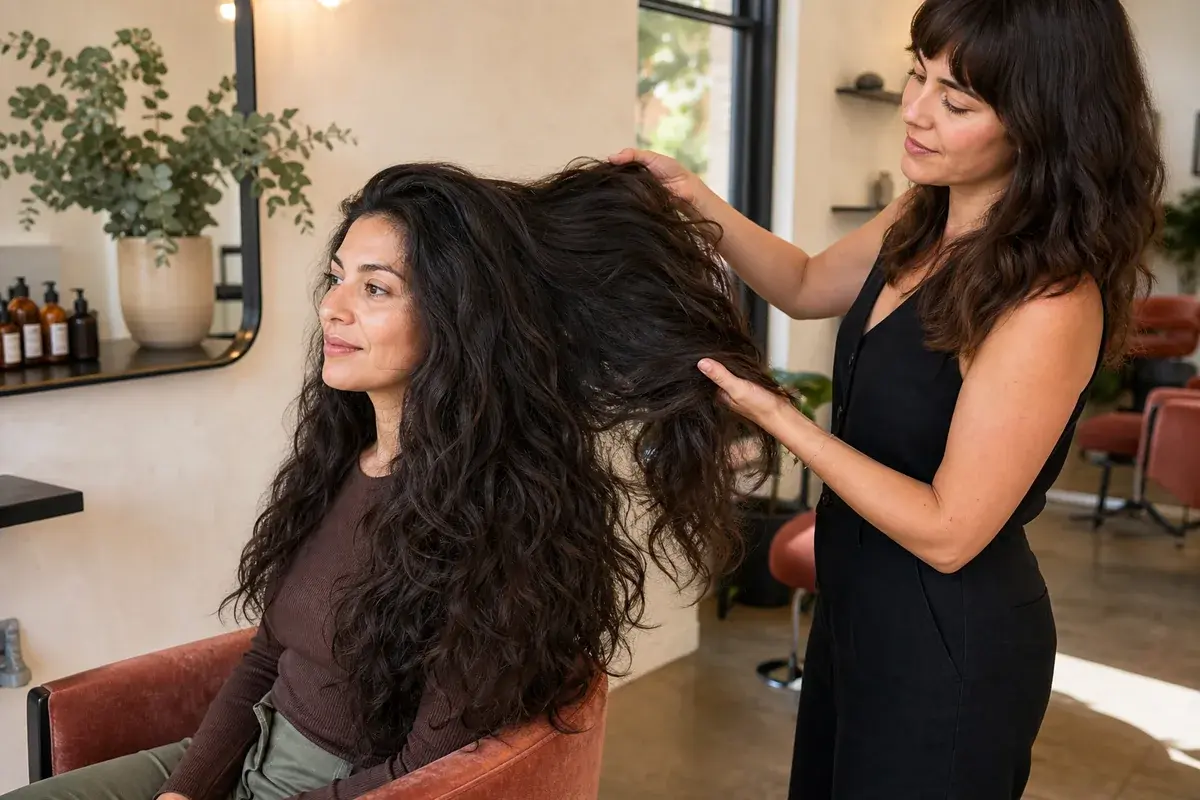
The most useful thick-hair haircut is not the one that removes the most hair. It is the one that places length, perimeter, and movement intentionally while preserving the volume you want. Begin by identifying whether you are describing individual strand diameter, the number of strands, or both.
Thick strands and high density are not the same
Thick hair can refer to two different characteristics:
- Strand thickness: the diameter of one hair strand, often described as fine, medium, or coarse.
- Hair density: how many strands grow within a given area of the scalp.
You can have coarse strands at lower density or fine strands at high density. Those combinations may create different silhouettes and respond differently to the same haircut. Use the hair diameter and density guide to separate the terms before choosing a direction.
Vogue’s current thick-hair haircut guide also distinguishes strand thickness from density and emphasizes placing weight to create movement rather than treating all volume as a problem. That is the principle behind this ranking.
| Factor | Question to answer before choosing |
|---|---|
| Weight distribution | Where does the hair feel or look concentrated now? |
| Movement | Do you want a strong perimeter, visible layers, or both? |
| Texture | Will the cut usually be worn straight, wavy, curly, coily, or in several finishes? |
| Routine | Do you air-dry, diffuse, blow-dry, use tools, or tie it back? |
| Length commitment | Which drying time, tie-back ability, and grow-out pattern are acceptable? |
How we ranked the options
We ranked each haircut by its adaptability across textures, ability to distribute visible weight, potential for movement, styling burden, and range of length adjustments. A higher position means a broader starting point, not a rule for every person with thick or dense hair.
Overview of the seven haircuts
| Rank | Haircut | Strongest reason to choose it | Main tradeoff |
|---|---|---|---|
| 1 | Long graduated layers | Movement while preserving long length | Layers may need styling to appear distinct |
| 2 | Butterfly cut | Dramatic face framing with a long back | Short front pieces change tie-back and styling |
| 3 | U-shaped long cut | Full perimeter with a softer back outline | Retains much of the length and wash-day work |
| 4 | Internally shaped lob | Compact medium length with adaptable weight | Shoulder contact and perimeter need planning |
| 5 | Long shag | Texture-forward movement and a relaxed outline | Short crown or fringe can add daily resetting |
| 6 | Curly shag | Layered curl silhouette across several lengths | Shrinkage and pattern variation require adaptation |
| 7 | Layered pixie | Short, deliberate shape with reduced length | Growth patterns and reshaping become more visible |
1. Long graduated layers
Who it suits: Someone who wants to keep long hair but wants its shape to move rather than fall as one concentrated mass.
Why it ranks: Long layers offer the broadest range of starting lengths and can be adapted to straight, wavy, curly, or coily hair.
Main benefit: They can distribute visible weight through the lower and middle lengths while retaining a substantial perimeter and tie-back flexibility.
Limitation: Subtle layers may disappear without the finish used in the reference, while more pronounced layers can change air-dry behavior and shorter-piece management.
How to adapt it: Decide how high you want visible movement to begin and which pieces must still reach your normal tie-back. Show both your preferred styled finish and your typical everyday finish.
2. Butterfly cut
Who it suits: Someone who wants long hair with more noticeable face framing and a layered, outward-moving silhouette.
Why it ranks: The butterfly cut creates a clear distinction between shorter front layers and longer back sections, making it a meaningful alternative to uniformly long layers.
Main benefit: It can make dense long hair feel visually dynamic without giving up the long back perimeter.
Limitation: The shorter front sections may require styling to create the signature shape and may escape some ponytails or braids.
How to adapt it: Choose the shortest front point according to your routine and natural movement, then ask the hairstylist how the transition can work with your density.
3. U-shaped long cut
Who it suits: Someone who likes the substantial feel of long hair and wants a softer back outline without many short layers.
Why it ranks: A rounded U-shaped perimeter creates more length through the center back and shorter corners while keeping the ends visually present.
Main benefit: It balances a full perimeter with a less block-like outline and can support braids, ponytails, and long styling.
Limitation: It preserves most of the overall mass, so washing, detangling, and drying work may remain significant.
How to adapt it: Decide how pronounced the U should be and whether limited long layering would help movement without sacrificing the perimeter you value.
4. Internally shaped lob
Who it suits: Someone ready to remove substantial length but still wants a versatile medium cut and some tie-back potential.
Why it ranks: A shoulder-length lob provides a readable shape while leaving room for a hairstylist to adapt the internal structure to the hair.
Main benefit: It reduces long-hair drying and detangling while preserving more styling flexibility than a jaw-level bob.
Limitation: Ends can turn where they meet the shoulders, and a strong perimeter can look wider or more compact depending on density and texture.
How to adapt it: Place the perimeter above or below the shoulder point that disrupts the ends, and explain whether you want compact fullness or softer movement inside the outline.
5. Long shag
Who it suits: Someone whose style favors visible layers, natural movement, and a less geometric perimeter.
Why it ranks: A long shag makes layered variation part of the design, which can work especially well when wave or texture is meant to remain visible.
Main benefit: It can distribute the silhouette from crown to ends and make an intentionally relaxed finish easier to recognize.
Limitation: Shorter crown pieces or fringe can require refreshing, and the shape may not suit someone who wants every piece contained in a tie-back.
How to adapt it: Keep the crown and fringe longer when grow-out or tie-back matters, and use references with a texture and density relevant to yours.
6. Curly shag
Who it suits: Someone who wants curls or coils to form a layered silhouette with movement around the face and crown.
Why it ranks: A curly shag treats varied curl placement as the visual structure rather than asking every section to finish at one apparent length.
Main benefit: It can distribute a dense curly outline and create intentional space between curl groupings.
Limitation: Curl pattern variation, shrinkage, density, and styling method make a generic layer map unreliable.
How to adapt it: Discuss dry visual length, typical shrinkage, preferred volume, and wash-day method. Let the hairstylist choose how to build the agreed silhouette.
7. Layered pixie
Who it suits: Someone comfortable with a major length change who wants a short shape that works with visible texture and volume.
Why it ranks: A pixie cut turns density and growth patterns into a compact silhouette rather than carrying them through long lengths.
Main benefit: It removes long-hair wash and drying tasks and can make natural direction or texture a deliberate feature.
Limitation: Cowlicks, expansion, sleep movement, and grow-out are more visible, while short sides and nape areas may need regular reassessment.
How to adapt it: Choose top, fringe, side, and nape lengths around your growth patterns and preferred finish. Discuss how the shape will change between appointments.
Choose your finalists
| Your priority | Start with | Compare against | Watch for |
|---|---|---|---|
| Keep long length and add movement | Long graduated layers | Butterfly cut | Shortest layer and tie-back reach |
| Preserve a strong long perimeter | U-shaped long cut | Long graduated layers | Remaining wash and drying work |
| Move to a practical medium length | Internally shaped lob | Long shag | Shoulder contact and air-dry shape |
| Emphasize natural texture | Long shag | Curly shag | Shrinkage, crown length, and fringe routine |
| Make a decisive short change | Layered pixie | Internally shaped lob | Growth patterns and reshaping needs |
Compare these choices with the fine-hair ranking if you are still deciding whether strand diameter or density is driving your concern. If curls shape the silhouette, use the curly-hair ranking to compare shrinkage and pattern-specific tradeoffs. Use the haircut suitability guide to score finalists against your routine and commitment rather than choosing by hair type alone.
Compare silhouettes with Hair Fairy
After the independent ranking, compare finalist silhouettes in the women’s hairstyle directory or with Hair Fairy Custom Style. Keep the same source portrait and change one decision—such as length or layer emphasis—at a time.
A preview can make the visual difference between long layers, a lob, a shag, and a pixie easier to discuss. It cannot measure strand diameter or density, predict natural movement, or specify the right cutting method. Use the controlled comparison method, then take the finalists to your hairstylist with the four-part consultation brief.
Direct recommendation
Start with long graduated layers when you want the most adaptable balance of length and movement. Choose a butterfly cut for stronger face framing, a U-shaped cut for a fuller long perimeter, a lob for a medium reset, a long or curly shag for texture-led movement, or a layered pixie for a committed short shape. Finalize the silhouette first, then let your hairstylist decide how to achieve it for your strands, density, texture, and growth patterns.
Frequently Asked Questions
Questions about hair type and haircut choices
Are layers good for thick hair?
Layers can create movement and redistribute visible weight, but their length and placement need to suit your texture, density, styling routine, and desired perimeter. They are an option rather than a universal requirement.
Can thick hair look good short?
Yes. A layered pixie, bob, or lob can create a clear short shape, but growth patterns, natural volume, styling preferences, and reshaping needs should be discussed before choosing the length.
What kind of bob works for thick hair?
A lob with adaptable internal shaping is a versatile starting point because it keeps more length than a jaw-level bob. The perimeter and internal structure should be chosen for the way your hair naturally falls.
How can a haircut reduce bulk in thick hair?
A haircut can change the silhouette and redistribute weight through its shape, length, and internal structure. Ask for the visible effect you want and let your hairstylist select a suitable method after assessing your hair.
Is thick hair the same as dense hair?
No. Thickness describes the diameter of an individual strand, while density describes how many strands grow within an area. You may have thick strands, high density, both, or neither.
Should thick hair be cut with thinning shears?
Not automatically. Tool and technique choices depend on texture, condition, growth pattern, desired shape, and the hairstylist’s assessment. Describe the weight and movement you want rather than requesting one tool for every area.
About This Guide
Hair Fairy EditorialEditorial team, Hair Fairy
Hair Fairy Editorial writes and reviews Hair Fairy guides with a focus on realistic haircut decisions, clear salon communication, and styles that work beyond the inspiration photo. The team balances visual ideas with texture, maintenance, and everyday wear.
Women’s haircut selection, face-shape and texture considerations, salon-reference planning, maintenance trade-offs, clear stylist communication, and responsible use of AI hairstyle previews as decision aids rather than guarantees.
View author profileSee us more often in Google
One click marks Hair Fairy as a preferred source, so our articles are more likely to appear in your Top Stories, and can show a preferred badge in AI Mode and AI Overviews.
Compare Your Idea
Preview a hairstyle on your own photo.
Use a reference, a written description, or both—then discuss the practical result with your stylist.