
Haircut Decision Guides
How to Choose an Asymmetrical Haircut: 4 Checks Before Cutting
Choose an asymmetrical haircut by testing a temporary side imbalance, mapping both dry endpoints, checking routine, and planning upkeep and grow-out.
Choose an asymmetrical haircut by testing whether you enjoy unequal sides, naming the shorter and longer dry endpoints on your own head, checking the cut with your usual part and texture, and accepting its maintenance and exit plan. Start with a modest length difference if you want a gradual commitment; choose a cropped or shaved side only when you also want that separate grow-out.
Key Takeaways
- A side part or ear tuck can create temporary visual imbalance; unequal cut lengths make a longer commitment.
- Specify your own left and right sides, because mirrors and reference images can reverse the intended direction.
- Check both sides down, tucked, and in motion before approving an outline that depends on a particular part.
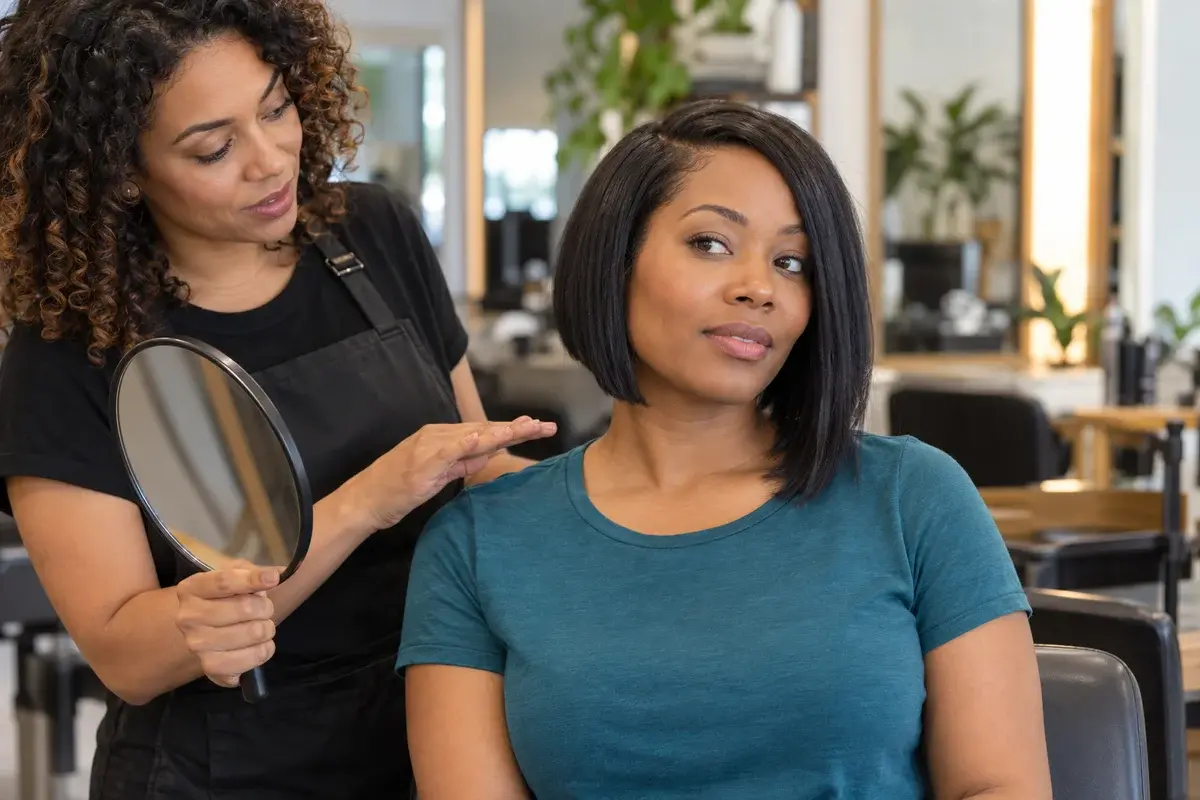
An asymmetrical haircut can be a small difference between two bob sides or a much larger contrast between a crop and longer hair. The decision is how much permanent difference you want to wear. This guide handles that side-to-side choice; use the haircut suitability guide for the broader length, texture, and routine audit.
Step 1: Test the visual imbalance before cutting
Begin with your hair as you normally wear it. Try a comfortable ear tuck or a different side placement to expose more of one side of the face. Take an upright front photo, then reverse the arrangement. This does not reproduce an asymmetrical cut, but it can reveal whether you enjoy its basic direction.
Hair.com's asymmetrical-haircut guide, published by L'Oréal's professional products division, distinguishes unequal sides from temporary styling approaches and emphasizes planning the part. Use that distinction to decide whether you want a new cut or occasional styling variety. Its inspiration examples are not a requirement to change your hair.
Look at both arrangements while talking, turning your head, and wearing glasses or earrings you use regularly. If the effect only appeals when one side is pinned completely away, note that: you may prefer a removable styling choice to a shorter side.
Separate two possible goals: “I want one cheek and ear more exposed” and “I want a clearly diagonal lower outline.” The first might be achievable with a tuck; the second may require an actual length difference.
Output: a photo of your preferred direction and a sentence describing the effect you want.
Step 2: Name both dry endpoints and the connection
Choose a baseline length family before setting the difference: lob, bob, or pixie. The asymmetrical bob and asymmetrical pixie directory pages show different commitments. A longer side does not restore the tie-back function lost on the shorter one.
Point to the intended shortest and longest dry endpoints on your own hair. Use “my left side near the jaw” and “my right side near the lower neck,” rather than “this side” while pointing at a mirrored selfie. Ask how the line would connect around the back. A front image cannot show that transition.
| Direction | Useful starting priority | Commitment to check |
|---|---|---|
| Subtle difference in a lob | Keep most length while adding visible direction | Whether the difference remains readable in your usual texture |
| Clearly unequal bob sides | Make side-to-side geometry central to the cut | Short-side tuck, nape connection, and perimeter upkeep |
| Pixie with a longer side or front | Combine a cropped base with directional length | Short-side resetting and a longer route back to a bob |
| Cropped or shaved side | Deliberately expose one side | Separate upkeep and grow-out of the very short section |
An A-line bob is a useful comparison if you like an angled perimeter but want similar left and right sides. Front-to-back angle and side-to-side asymmetry are different design choices, even when one haircut combines them.
Output: two named dry endpoints, the preferred side orientation, and a back-view reference.
Step 3: Check the design against your normal part and texture
Show the stylist where your hair naturally separates and whether you switch parts. Ask to see the proposed shape with both sides down before relying on an ear tuck to complete it. The part-placement guide helps distinguish a part preference from a cut decision.
Check the design in the finish you actually maintain. A precise straight outline in a reference may read as a softer difference in waves or curls. That can be an appealing outcome; decide whether you want a clear diagonal edge or an overall uneven silhouette. Ask the stylist to assess dry shrinkage and different curl patterns rather than prescribing equal measurements on stretched sections.
Include strand diameter, density, growth patterns, hairline behavior, and condition in the discussion. Face shape can help describe where you prefer exposure; it does not prescribe which side is allowed to be shorter.
Test practical constraints explicitly: Does the short side reach a comfortable tuck? Will hair fall forward when you look down? Can you gather the sections needed for work? Would your normal headwear flatten the part the design depends on? If an essential function fails, adjust the endpoints or choose styling asymmetry instead.
Output: a list of functions the shorter side must retain, with any necessary endpoint revision.
Step 4: Agree upkeep and an exit plan
Discuss which detail makes the haircut feel intentional: the nape, shortest side, longer edge, or contrast between sides. Ask what change would signal a reshaping visit. Avoid assuming that every asymmetrical cut needs one fixed interval. A soft lob and a shaved-side crop have different visible maintenance triggers.
Plan the return route before the first cut. You can let the short side grow while retaining the difference, shorten the long side gradually, or move toward an intermediate shape. Making the sides equal immediately can mean removing more length than you expected. Use the haircut interval guide to separate shape upkeep from care of the ends.
If maintaining the look requires daily heat you do not want to use, revise the design. The American Academy of Dermatology's styling guidance cautions that excessive heat can damage hair. A reference finish should not become an unexamined daily obligation.
Output: a maintenance trigger, an acceptable grow-out route, and a less-committed fallback.
Your asymmetrical-cut consultation brief
EFFECT: I want [more exposure on one side / a diagonal outline / a subtle difference].
ORIENTATION: My [left / right] side should be longer; confirm this on my head.
ENDPOINTS: Short side at [dry point], long side at [dry point].
PART AND FINISH: I usually wear [part] and [drying routine].
FUNCTION: The shorter side still needs to [tuck / stay clear / gather loosely].
EXIT: If I grow it out, I prefer [preserve length / gradually reduce the difference].
Common asymmetrical-cut mistakes
Confusing a side-swept photograph with unequal cut lengths. Ask to see the haircut with both sides down and the part visible.
Reversing the desired side. Confirm left and right on your own head, especially if the reference is a mirror image.
Choosing the longest side first and ignoring the shortest. The shortest endpoint often determines the biggest functional commitment.
Adding a shaved side by default. It is a separate choice, not part of the definition of asymmetry.
Evaluating only a front view. Ask how the back connects and whether the longer section still looks intentional from the opposite side.
Compare side lengths with Hair Fairy
Once your brief is clear, use Hair Fairy Custom Style with a reference photo, written description, or both. Compare a small and a larger side-to-side difference using the same portrait, baseline length, color, and texture direction. Follow the controlled comparison guide to hold unrelated details steady.
Check every result against the requested orientation. Reject a reversed side, changed face, altered hairline, invented density, or unexpected straightening. A front preview cannot establish the back connection, dry behavior, cutting technique, upkeep, or salon feasibility. Review the privacy policy before uploading and bring the preferred image beside your endpoint brief and real-hair references.
Decision summary
Choose the smallest permanent side difference that creates the effect you want while preserving essential function. Approve both dry endpoints, orientation, part, and back connection together. If temporary styling already gives you the preferred exposure, you can keep that option; if you want the cut itself to carry the contrast, take the agreed upkeep and grow-out plan to the appointment.
Frequently Asked Questions
Questions about choosing and maintaining a haircut
What makes a haircut asymmetrical?
For this guide, it means the cut deliberately differs in length or shape between the two sides. An even haircut worn in a deep side part can create a similar visual effect without having unequal cut lengths.
Is an asymmetrical bob the same as an A-line bob?
No. An A-line bob generally describes a front-to-back angle, often longer toward the front. An asymmetrical bob describes a difference between the left and right sides. A haircut can combine both features, so point to each endpoint.
Which side should be longer in an asymmetrical haircut?
There is no required side. Compare your usual part, hairline, curl pattern, ear-tucking preference, and the face exposure you enjoy. Describe the choice as your own left or right side to avoid a mirrored-reference mix-up.
Can curly hair be cut asymmetrically?
Yes. Plan the visible dry difference with a stylist who can assess curl variation and shrinkage. Equal differences measured on stretched strands do not necessarily produce the same visible difference once curls settle.
Does an asymmetrical haircut require an undercut?
No. A difference in perimeter length can create asymmetry without shaving. An undercut adds a separate decision about exposure, upkeep, and growing a short section back into the surrounding length.
How do I grow out an asymmetrical haircut?
Decide whether to keep the longer side while the shorter side grows, gradually shorten the longer side, or move to an intermediate outline. Ask a stylist to map the stages; immediately making both sides equal may mean a shorter overall cut than you want.
About This Guide
Diane BennettBlog author, Hair Fairy
Diane Bennett writes Hair Fairy guides about haircut decisions, everyday hair routines, and preparing clear questions for a hairstylist.
Haircut comparison, salon planning, and responsible use of visual hairstyle previews.
View author profileSee us more often in Google
One click marks Hair Fairy as a preferred source, so our articles are more likely to appear in your Top Stories, and can show a preferred badge in AI Mode and AI Overviews.
Compare Your Idea
Preview a hairstyle on your own photo.
Use a reference, a written description, or both—then discuss the practical result with your stylist.