
AI Hairstyle Tools
How to Compare Hairstyles on Your Face Before You Choose
Compare hairstyle previews fairly by holding your portrait constant, changing one feature at a time, rejecting invalid results, and scoring finalists.
 Hair Fairy Editorial8 min read
Compare hairstyles on your face by using the same clear portrait for every preview, changing only one haircut feature at a time, rejecting images that alter your face or contain visible generation errors, and scoring the valid results against the same practical criteria. The most convincing image is not automatically the most suitable or salon-feasible haircut.
Key Takeaways
- Keep the source portrait, pose, lighting, expression, and hair color constant so the haircut is the main variable.
- Reject a preview when facial features, head shape, hairline, background, or basic hair geometry change in ways unrelated to the haircut.
- Score two or three valid finalists for silhouette, desired details, routine, commitment, and questions to confirm with a hairstylist.
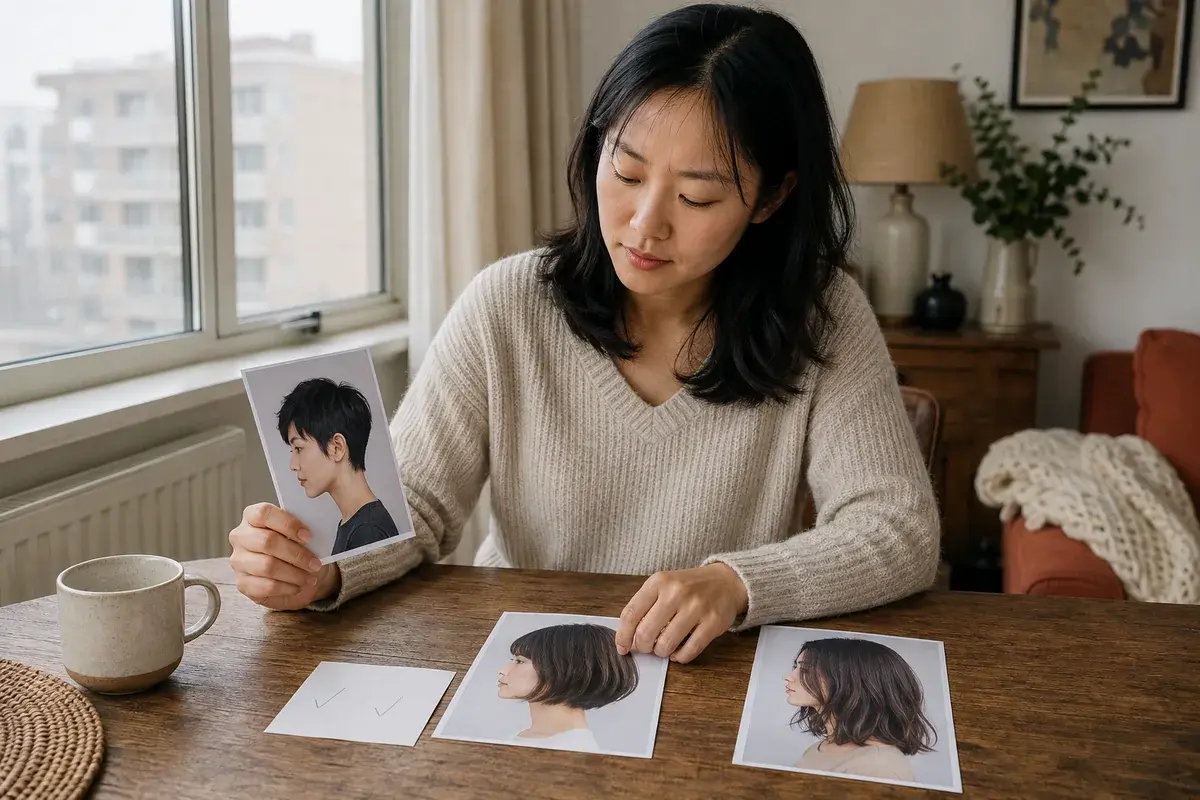
A fair hairstyle comparison is a controlled visual test, not a search for the single prettiest image. Decide which haircut variable you are testing, keep everything else as stable as possible, and separate image quality from the practical haircut decision.
Step 1: Hold the source portrait constant
Choose one clear, recent portrait and use it for the complete comparison. A different selfie introduces a different angle, expression, lens distance, light, background, and starting hairstyle. You may end up preferring the photograph rather than the haircut.
Use a portrait with:
- a straight-on or slightly turned head position
- even light across the face and hairline
- a relaxed, recognizable expression
- the full head and some shoulder area inside the frame
- no hat, hand, heavy shadow, or foreground object covering the hair
- enough contrast between hair, clothing, and background
Hairstyle-transfer research explains why this consistency matters. HairFIT identifies pose differences, face size, occlusion, and reconstruction as challenges in hairstyle transfer. StyleGAN Salon likewise documents failures involving semantic regions, face keypoints, lighting, hair-background similarity, and unusual hairstyle geometry. Those papers evaluate particular methods, but the failure categories are useful checks for any visual preview.
If your portrait is unsuitable, replace it before the test and regenerate the full set. Do not compare one candidate on the old portrait with another on the replacement.
Step 2: Change one hairstyle feature at a time
Start with three distinct silhouettes rather than many small variations. For example, compare a pixie cut, blunt bob, and shoulder-length lob while holding texture, part, and color steady. Once you choose a length family, compare layers, bangs, or parting within that family.
| Test round | Change | Keep constant | Decision it answers |
|---|---|---|---|
| 1. Length | Pixie, bob, lob, or long | Portrait, color, texture, part | Which length range deserves more attention? |
| 2. Perimeter | Blunt, rounded, angled, or layered | Chosen length and other traits | Which outer shape creates the emphasis you want? |
| 3. Layers | Minimal, long, face-framing, or shaggy | Length, color, texture | How much visible movement do you prefer? |
| 4. Front | Open forehead, curtain shape, side sweep, or bangs | Back and side silhouette | Which front detail feels most useful? |
| 5. Texture | Natural finish or a realistic styled finish | Cut structure and color | Does the idea still appeal in your normal routine? |
| 6. Color | Current color or one intended change | Final haircut and portrait | Is color part of the decision? |
Write the tested variable above each result. Without that label, a folder of similar images becomes difficult to interpret later.
Step 3: Reject invalid previews
Judge validity before preference. A polished image can still be a poor test if it changes the person, ignores the requested shape, or invents inconsistent hair.
Reject or regenerate a preview when:
- eye, nose, mouth, jaw, skin tone, or expression changes noticeably
- head or neck proportions shift without a haircut reason
- the hairline breaks, duplicates, floats, or cuts through the face
- hair merges with a collar, hand, earring, wall, or background
- strands or curls form impossible connections or inconsistent directions
- the result silently changes color, texture, bangs, or length you meant to hold constant
- the requested haircut is not recognizable
- the image depends on a camera crop that hides the feature being compared
Do not reward or penalize the haircut for a generation error. Mark the result invalid and run the same test again. A realistic face with an inaccurate haircut is also invalid for this decision.
Step 4: Score and shortlist the finalists
After removing invalid outputs, compare the remaining candidates against the same questions. A simple score helps reveal why one direction is stronger instead of relying only on an immediate emotional reaction.
Use a 1–5 score, where 1 means poor fit with your stated goal and 5 means strong fit:
| Criterion | What to evaluate | Candidate A | Candidate B | Candidate C |
|---|---|---|---|---|
| Desired silhouette | Does the overall length and outline create the effect you wanted? | |||
| Important details | Are the perimeter, layers, bangs, and part represented clearly? | |||
| Everyday routine | Can you imagine the cut with your normal drying and styling habits? | |||
| Practical flexibility | Does it preserve the tie-back, work, exercise, or climate needs that matter? | |||
| Change commitment | Are you comfortable with the amount of length removed and likely grow-out? | |||
| Consultation questions | Can you explain what must be adapted or verified? |
The numbers organize your reasoning; they do not calculate objective suitability. Keep the two highest-scoring directions and note why each remains in contention.
Hairstyle comparison worksheet
Copy this for every candidate:
CANDIDATE: [haircut name or short description]
VARIABLE TESTED: [length / perimeter / layers / front / texture / color]
WHAT I LIKE: [specific visible details]
WHAT I WOULD CHANGE: [one or two adaptations]
VALIDITY CHECK: [face preserved / hairline coherent / background clean / request represented]
ROUTINE QUESTION: [what you need to know about daily wear]
SALON QUESTION: [what a hairstylist needs to assess]
TOTAL SCORE: [sum of the six criteria]
Use the haircut suitability guide to define your criteria, the reference-photo guide to select realistic examples, and the hairstylist consultation brief to prepare the finalists for an appointment.
Common comparison mistakes
Changing the selfie between candidates
You cannot isolate the hairstyle when the face angle and light also change. Restart the set with one portrait.
Testing color, length, texture, and bangs together
The result may be exciting, but it does not tell you which change you prefer. Separate the variables.
Choosing the most polished generation
Image polish is not haircut suitability. First check whether the requested structure is present and whether the person is preserved.
Ignoring an inaccurate result because it looks attractive
If a “bob” becomes longer, fuller, or more layered than requested, it cannot fairly represent that candidate.
Treating a front view as complete evidence
A portrait preview cannot show the unseen back, internal structure, or how your hair moves. Use real-hair references and professional consultation for those questions.
Mistaking preference for feasibility
You are allowed to prefer any silhouette. Whether your current hair can produce it, and what adaptation it needs, remain separate salon questions.
Run the controlled test with Hair Fairy
After defining the test, use the women’s hairstyle directory or Hair Fairy Custom Style to create the comparison. Custom Style accepts a hairstyle reference, a written description, or both. It can keep the source portrait’s hair color or use the reference color, so keep the source color selected until color is the variable you intend to test.
Use one source portrait throughout, save the valid candidates, and review the privacy policy before uploading. A Hair Fairy result is a visual decision aid. It does not measure texture or density, confirm a cutting method, or guarantee salon feasibility.
If curls are among your finalists, compare the shapes in the curly-hair haircut guide. If the length decision includes a pixie or bob, use the short-hair decision guide before your consultation.
Decision summary
Use one portrait, test one variable at a time, reject results with identity or hair-geometry errors, and score only valid candidates against the same practical criteria. Take two finalists—not a verdict—to your hairstylist, along with real-hair references and the questions the preview cannot answer.
Frequently Asked Questions
Questions about AI hairstyle comparisons
How many hairstyles should I compare at once?
Start with three meaningfully different directions, then narrow to two finalists. A small set makes differences easier to identify and keeps the decision focused.
Should I use the same selfie for every hairstyle preview?
Yes. Keeping the portrait, pose, expression, lighting, and framing constant makes the hairstyle the main variable and produces a fairer comparison.
Should I change hair color while comparing haircuts?
Keep color constant during the first comparison unless color is the decision you are testing. Changing color and shape together makes it harder to know which difference affected your reaction.
What errors make a hairstyle preview invalid?
Reject a result when it changes facial features or head shape, creates broken hairlines or impossible strands, merges hair with clothing or background, or fails to represent the requested haircut.
How should I compare a pixie, bob, and lob?
Use the same portrait and similar texture and color, then compare visible length, perimeter, face exposure, tie-back ability, styling expectations, and grow-out commitment.
Does the best-looking AI preview predict the salon result?
No. A preview helps compare visual directions, but it cannot predict how your natural texture, density, growth patterns, condition, shrinkage, or a stylist’s technique will shape the result.
About This Guide
Hair Fairy EditorialEditorial team, Hair Fairy
Hair Fairy Editorial writes and reviews Hair Fairy guides with a focus on realistic haircut decisions, clear salon communication, and styles that work beyond the inspiration photo. The team balances visual ideas with texture, maintenance, and everyday wear.
Women’s haircut selection, face-shape and texture considerations, salon-reference planning, maintenance trade-offs, clear stylist communication, and responsible use of AI hairstyle previews as decision aids rather than guarantees.
View author profileSee us more often in Google
One click marks Hair Fairy as a preferred source, so our articles are more likely to appear in your Top Stories, and can show a preferred badge in AI Mode and AI Overviews.
Compare Your Idea
Preview a hairstyle on your own photo.
Use a reference, a written description, or both—then discuss the practical result with your stylist.