
Salon Planning
How to Choose a Wet or Dry Haircut: 4 Questions to Ask
Compare wet cutting, dry cutting, and a combined appointment by your everyday finish, length limits, and the checks you want before leaving the salon.
Choose a wet or dry haircut by showing your everyday dry texture, naming the shape you want, asking how the stylist will control length, and agreeing on a final dry check. A combined appointment can use both approaches. Choose the professional workflow that addresses your priorities rather than treating either method as universally better.
Key Takeaways
- Show the finish you actually wear before the hair is washed or stretched.
- Ask which part of the appointment establishes the shape and which checks the dry result.
- Confirm arrival instructions and the shortest acceptable dry endpoint.
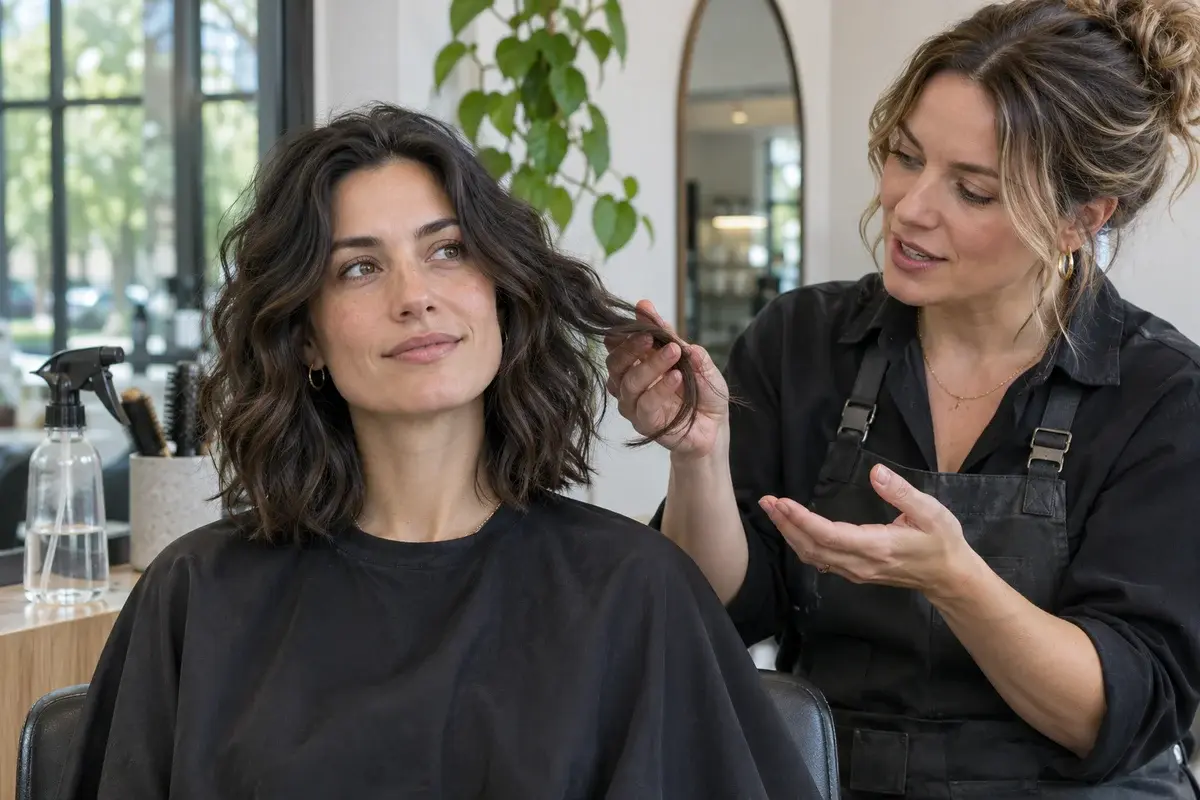
Step 1: Show the finish you actually wear
Before booking, take front, side, and back photos after your normal drying routine. Note whether the hair was stretched, brushed out, diffused, or left to settle. Bring these photos even if the appointment includes a shampoo. They give the stylist information that disappears when you arrive with a different finish.
Write one observation beside each view: the right side springs higher, the front turns outward, or the nape lies close. These are descriptions, not measurements of hair health. If you alternate finishes, use the curly-and-straight haircut guide to define which one takes priority.
Output: three dry photos and one sentence naming your primary finish.
Step 2: Separate the desired shape from the method
Say what you want to see before asking for a named technique. A clear bottom edge, less width beside the jaw, and a shorter front are outcomes. Wet cutting and dry cutting describe the state of the hair during some of the work; they do not fully specify the haircut.
Sam Villa's professional layering demonstration establishes guides on wet hair and later uses dry finishing to assess the shape. It is one example of a combined workflow, not evidence that every haircut needs the same sequence.
| Your main priority | Question to ask | What to confirm |
|---|---|---|
| A defined perimeter | How will you establish and check the bottom edge? | Where the edge sits in your everyday finish |
| Uneven curl endpoints | When will you assess my unstretched pattern? | Which sections should retain extra length |
| Less visible bulk | Can you show which area needs changing? | Whether changing the outline is enough |
| Two different finishes | How will you check the second finish? | The compromise you are accepting |
Output: one desired shape and a question about how the proposed workflow serves it. Leave tool choice and cutting technique to the professional.
Step 3: Agree on dry length and handling limits
Point to the shortest acceptable endpoint on your own dry hair. Ask how the stylist will account for the difference between that endpoint and the hair as it is held during cutting. Avoid converting a wet measurement into a promised dry result yourself.
Handling matters as well as water. The American Academy of Dermatology's hair-care guidance recommends gentle detangling and adapting combing to hair texture. That advice supports careful handling; it does not establish which cutting method is best. Tell the stylist if detangling hurts or if you want to avoid a heat-straightened finish.
For example: “My front should stay below my chin in its normal dry curl. Please show me the proposed endpoint before shortening that section.” If the hair is already shorter than your limit in places, ask what can be preserved today rather than expecting the appointment to make every section match.
Output: a dry length boundary and any handling or finishing preferences.
Step 4: Book the preparation and final check together
Ask the salon how to arrive, what the service includes, and when you will review the result. Do not assume that a dry-cut booking means arriving without product or that a wet-cut booking includes time for your usual curl finish. Follow their specific instructions and explain anything you cannot reproduce at home.
Before leaving, look at the front, both sides, and back with the hair released. Check the agreed length and movement, and ask how the salon finish differs from your everyday one. If a further adjustment is proposed, confirm its effect on your protected sections first.
Appointment note: I normally wear [finish]. I want [visible shape]. Please preserve [dry endpoint]. I would like to understand [wet/dry stages], arrive with [agreed preparation], and review [specific area] before any extra shortening.
Output: a confirmed service plan. The curly appointment checklist gives additional preparation questions when curl pattern is central to the decision.
Common mistakes
- Choosing solely by a service label without asking what happens during the appointment.
- Arriving with stretched hair when the stylist requested your usual natural finish.
- Treating gentle wet-hair care guidance as proof that wet cutting is wrong.
- Requesting another all-over trim when only one area needs review.
Compare the goal with Hair Fairy
Once the service questions are clear, use Custom Style to compare two visible outlines on the same portrait. Keep color, part, texture direction, and lighting constant. Reject a result that changes your face, straightens curls you meant to preserve, or adds unrequested layers. Review the privacy policy before uploading.
A preview can illustrate a preferred silhouette. It cannot choose wet versus dry cutting, measure shrinkage or density, prescribe technique, confirm feasibility, or guarantee the salon result. Bring two finalists alongside your real dry photos and ask the stylist how they would adapt them.
Decision summary
Choose the appointment by the information it preserves and the checks it includes. Show your real finish, describe the desired shape, protect a dry endpoint, and confirm arrival instructions and the final review. A stylist who can explain those choices gives you a more useful plan than a method label alone.
Frequently Asked Questions
Questions about planning your haircut
Is a dry haircut always better for curly hair?
No. Ask a stylist experienced with your texture how they account for pattern variation and the dry endpoint. The method and the final check should suit the shape and finish you actually wear.
Can a haircut use both wet and dry cutting?
Yes. A stylist may establish a shape wet and refine it dry. Ask what each stage is intended to accomplish and whether the dry finish resembles your normal routine.
Should I wash my hair before a dry haircut?
Ask the salon before the appointment. Describe the products, braids, heat styling, or tie-back marks currently in your hair so they can give suitable preparation instructions.
Does dry cutting mean there is no shampoo?
Not necessarily. Service names vary. Confirm whether washing, drying, styling, and a final shape check are included in the appointment you book.
What if I wear my hair both curly and straight?
Bring dry photos of both finishes and name the one you wear most. Agree on acceptable endpoints in each; one finish may require a compromise.
About This Guide
Diane BennettBlog author, Hair Fairy
Diane Bennett writes Hair Fairy guides about haircut decisions, everyday hair routines, and preparing clear questions for a hairstylist.
Haircut comparison, salon planning, and responsible use of visual hairstyle previews.
View author profileSee us more often in Google
One click marks Hair Fairy as a preferred source, so our articles are more likely to appear in your Top Stories, and can show a preferred badge in AI Mode and AI Overviews.
Compare Your Idea
Preview a hairstyle on your own photo.
Use a reference, a written description, or both—then discuss the practical result with your stylist.