
Hair Type Guides
How to Choose a Haircut You Wear Curly and Straight
Choose a haircut for both curly and straight styling by prioritizing your usual finish, recording dry endpoints, and agreeing on acceptable compromises.
Choose a haircut you wear curly and straight by naming your primary finish, documenting how the current cut looks in both states, setting length and shape limits for each, and agreeing a compromise with a stylist experienced with your texture. One cut can support both looks without producing identical outlines or maintenance needs.
Key Takeaways
- Give the finish you wear most often priority when requirements conflict.
- Specify separate dry endpoints for curly and straight wear.
- A second finish is a design check, not a reason to increase heat styling.
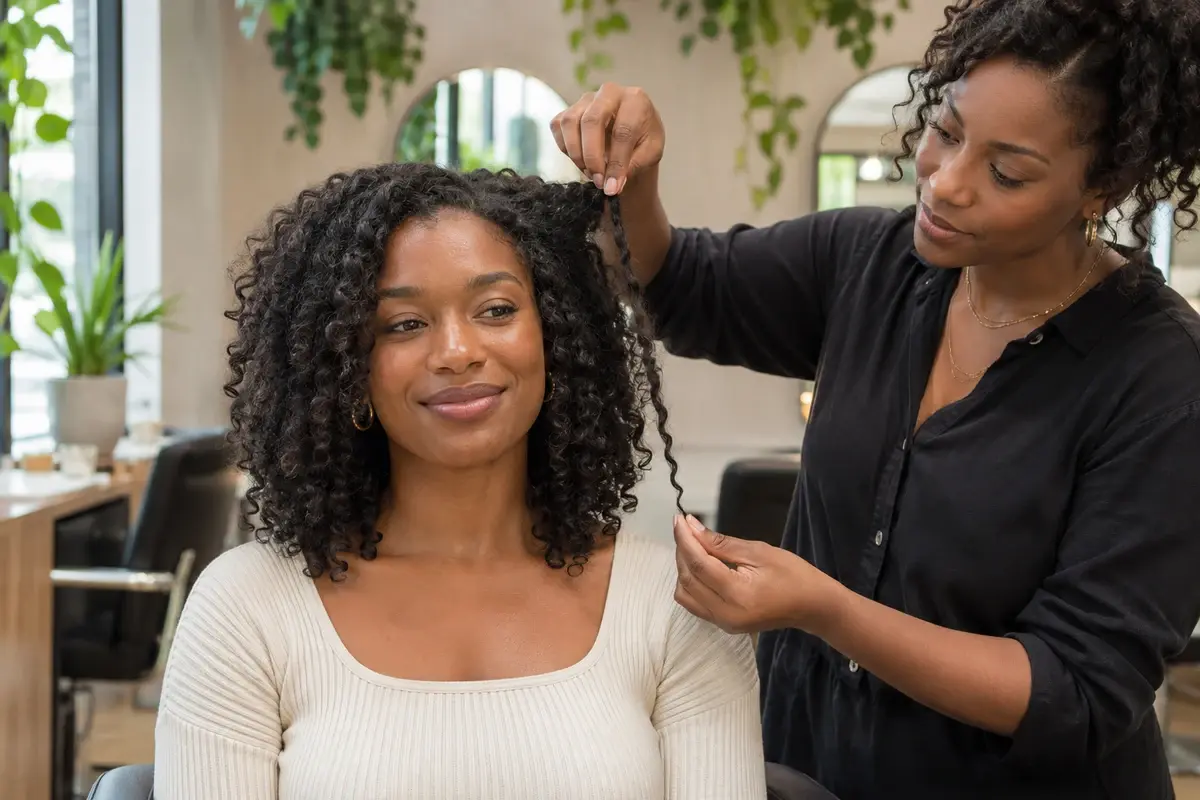
Step 1: Name your primary finish
Write down how you actually wore your hair over recent weeks: naturally curly, stretched, blown out, or straightened. Do not choose the primary finish based only on a special-event reference. If curls are your ordinary look and straight hair is occasional, say that plainly.
Also define what straight means to you. A soft blowout and a very smooth ironed finish are different references. Likewise, air-dried curls and a carefully diffused result may have different outlines. Use the curly haircut guide for shape options, then treat your secondary finish as a constraint rather than a competing ideal.
Your output is a primary finish, a secondary finish, and an honest account of how often you use each.
Step 2: Document both dry outlines
Gather existing front, side, and back photographs of both finishes at a similar current length. Note the date, part, and drying method. If you do not have straightened photos, tell your stylist; there is no need to apply extra heat simply to complete a worksheet.
Compare where the perimeter and shortest front sections end, where the sides look widest, and whether the back appears connected. Natural curls can rest at different endpoints from stretched hair, so the photographs are records of your hair under those conditions, not a fixed shrinkage formula.
The AAD’s healthy-hair guidance recommends limiting heat and using low or medium settings and heat protection when styling. A haircut plan should account for that burden rather than require extra straightening to remain wearable.
Your output is a small labeled photo set and two or three visible differences to discuss.
Step 3: Set separate length and shape limits
Write a shortest comfortable endpoint for each finish, using a landmark on your own body. Add the shape you want to preserve: curl volume, a substantial straight perimeter, front reach, or tie-back length. Do not assume every desired feature can be maximized simultaneously.
| Priority | Curly check | Straight check |
|---|---|---|
| Length | Where the curls rest after ordinary drying | Where the extended outline ends |
| Front sections | Whether curls clear eyes or reach a tuck | Whether the front connects as intended |
| Movement | Preferred distribution of curl volume | Acceptable visibility of layer differences |
| Practical use | Comfortable tie-back reach | Comfortable tie-back reach |
If a reference uses many short layers but you want a nearly continuous straight edge, flag the conflict. The layer decision guide helps describe the effect without prescribing cutting technique. Your output is one non-negotiable for each finish and one preference you can relax.
Step 4: Agree a compromise and finish check
Ask the stylist how they assess both finishes and how you should arrive; service methods vary. The curly appointment preparation guide covers that conversation. Share chemical-service history, condition concerns, and any sections that behave differently.
Ask which compromise preserves your primary finish and what the secondary look will require. That might mean retaining more length, accepting more visible layer separation when straight, or choosing less dramatic curl shaping. Let the stylist select the technique after examining your actual hair.
Agree how the second finish will be evaluated if it is not performed that day, including what photos or follow-up would be useful. Your output is a primary shape, an accepted secondary compromise, and a review plan. If you notice sudden shedding, patchiness, or persistent scalp symptoms, seek healthcare advice rather than treating a haircut as the solution.
Your consultation brief
My main finish is [method], worn [frequency]. My secondary finish is [method]. Keep curls no shorter than [landmark] and the straight outline no shorter than [landmark]. Preserve [priority]. I accept [specific compromise]. How will we assess the second finish?
Bring this note with your labeled photos. The hairstylist communication guide helps turn the requirements into a shared plan.
Common mistakes
Avoid promising yourself identical outlines, using a curl-type label as a cutting instruction, or giving two incompatible reference photos equal priority. Do not assume a cut performed in one finish has automatically been checked in the other.
Compare outlines with Hair Fairy
After completing the independent checks, use Hair Fairy to compare two visible directions on the same portrait. Hold color, part, and unrelated features constant; change only the length or outline under discussion. The controlled comparison guide explains how to shortlist the results. Reject images that alter your face, erase texture, distort ears or shoulders, or fail to show the requested change.
A preview cannot measure hair, establish natural behavior, simulate physical contact or movement, determine cutting technique, or guarantee salon feasibility or results. Take the finalists and your practical brief to a hairstylist. Review the privacy policy before uploading a portrait.
Decision summary
Choose the plan that serves your primary finish while keeping the second within your written limits. If the two ideals conflict, simplify the secondary shape or retain more length rather than approving a compromise you would not want to wear.
Frequently Asked Questions
Questions about hair type and haircut choices
Can one haircut work curly and straight?
It can support both, but the outlines may differ. Prioritize the finish you wear most and agree what compromise is acceptable in the other.
Should I arrive with curly or straight hair?
Ask the salon before the appointment. Explain that you wear both and follow its preparation instructions for the booked service.
Do I need to straighten my hair before choosing a cut?
No. Existing photographs may be enough for the initial discussion. Ask your stylist how to assess the secondary finish without adding unnecessary heat.
Should I choose the same target length in both finishes?
Set separate visible endpoints. Curls and stretched hair can rest differently, so a single verbal length may leave the intended result unclear.
Are layers always wrong if I also wear my hair straight?
No. Discuss how much layer separation you accept when straight and how much shape you want when curly. The adaptation depends on your actual hair.
Can previews predict both finishes accurately?
No. Previews can illustrate preferred silhouettes but cannot predict curl behavior, heat response, layer connections, or the result of a specific cutting method.
About This Guide
Diane BennettBlog author, Hair Fairy
Diane Bennett writes Hair Fairy guides about haircut decisions, everyday hair routines, and preparing clear questions for a hairstylist.
Haircut comparison, salon planning, and responsible use of visual hairstyle previews.
View author profileSee us more often in Google
One click marks Hair Fairy as a preferred source, so our articles are more likely to appear in your Top Stories, and can show a preferred badge in AI Mode and AI Overviews.
Compare Your Idea
Preview a hairstyle on your own photo.
Use a reference, a written description, or both—then discuss the practical result with your stylist.