
Hair Type Guides
How to Decide Whether to Use Thinning Shears
Decide whether thinning shears could ease bulk in one area while preserving the outline and fullness you want to keep.
Ask about thinning shears when you can point to a specific area that feels bulky and show your stylist which lengths should stay full. Check how that area sits when dry, compare targeted weight removal with a change to the shape, and agree on a small first pass with a chance to reassess.
Key Takeaways
- Show where the hair feels crowded and where you like the fullness.
- Ask how each option would affect the dry outline and existing layers.
- Point out the sections your stylist should leave untouched before work starts.
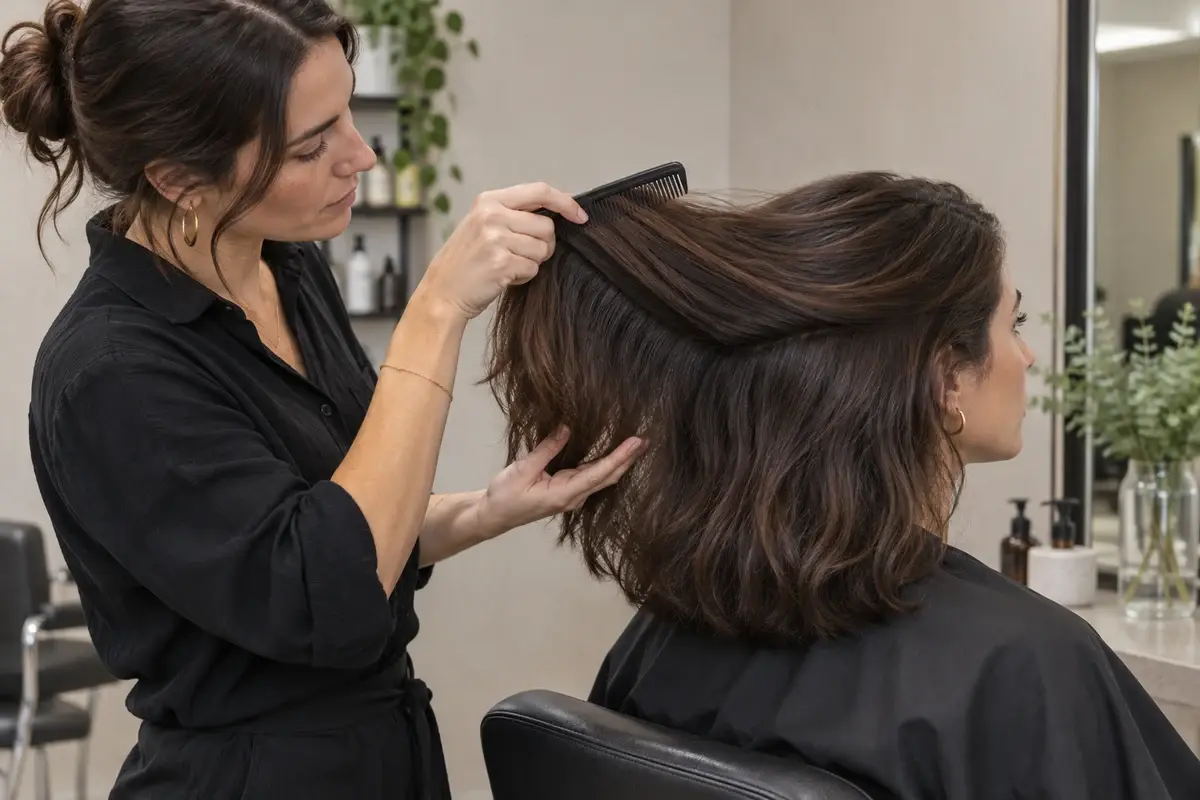
Step 1: Mark the area that feels bulky
Wait until your hair is dry in the finish you wear most. Use a mirror or a side photo and point to the smallest area you would change. It might be the shelf that forms behind both ears, or the section at the back that makes a clasp hard to close. Then mark an area you want to preserve, such as the edge that looks full against your shirt.
Tell your stylist when you notice the issue. Hair that fans outward only when you brush out your waves calls for a different discussion from hair that feels crowded in that spot every day. If you use “thick” to describe both the size of a strand and the amount of hair in a section, the strand diameter and density guide helps you describe each separately.
Step 2: Inspect what already supports the shape
Ask your stylist to lift the section and show you where the shorter pieces end. Mention any previous weight removal, even if it was several appointments ago. Look at the outer edge after the hair falls back into place. If you can see gaps in it already, ask which strands supply the coverage you want to retain.
Thinning or texturizing shears can shorten selected strands within a section to reduce its weight or soften an edge. The training team at CADMEN Barber Academy advises particular care around fine or sparse sections and sections already texturized. Ask your stylist what will happen when the shorter hairs dry in their usual pattern, especially near an exposed surface or part.
Step 3: Compare a shape change with localized weight removal
Use the smallest change that addresses the problem you demonstrated. Ask your stylist to explain how each route would affect the dry silhouette and what you would see as it grows.
| What you notice | Option to discuss | What to protect |
|---|---|---|
| The edge feels too solid across the bottom | Soften a small part of the edge | The continuous line you still want to see |
| One section feels crowded while the outline works | Remove some weight inside that section | The long surface strands and dry endpoint |
| Fullness sits higher or wider than you want | Change where the layers sit | The side coverage and length you use |
If the issue is where the cut widens, the guide to choosing haircut layers helps you describe the shape change before discussing tools.
Step 4: Agree on a small first pass
Point to the target area and have your stylist show you the area they plan to cut. If you want an incremental change, ask them to start in one section and let it fall before deciding whether to continue. Look at it from the side and back in your normal part. If the ends still look as full as you want and the problem area moves more freely, that may be enough for this visit.
“I want less bulk behind my ears. Please keep the bottom line and the hair that covers it. Can we start in one area and look at how it settles before doing more?”
Common mistakes
- Asking for thinning all over when only one area is hard to manage.
- Approving a tool before agreeing on the visible change.
- Judging the result only while the stylist holds the section away from your head.
Compare visible fullness with Hair Fairy
Use Custom Style to compare the same length and part with a fuller outline and a slightly narrower outline through the sides. Keep the source portrait, color, texture and front pieces consistent. Discard a result if it changes the perimeter length or smooths away waves you normally wear. A preview illustrates where you would like the silhouette to change. It cannot measure density, show what shortened strands will do, select a technique, confirm feasibility, or guarantee the cut. Bring your preferred outline and ask where your stylist would preserve weight.
Decision summary
If the outer shape works and one area feels crowded, ask about a localized change with a dry check before continuing. If the whole outline sits at the wrong height or width, discuss the cut shape first. Keep a clear boundary around any edge or section whose fullness you want to retain.
Frequently Asked Questions
Questions about hair type and haircut choices
Do thinning shears make hair less dense?
They shorten some strands within a section. That can change how full the section looks or feels, while the number of follicles in the scalp stays the same.
Can I ask for thinning shears only at the back?
Yes. Show the exact area at the back and ask whether changing that section alone would achieve your goal. Ask how the change would look from the side as well.
Can I get less bulk and still keep blunt ends?
It may be possible to reduce fullness inside a section while preserving the visible edge. Ask your stylist to show which longer strands support that edge before making the change.
Should I mention earlier thinning or layering?
Yes. Show any sections that already have shorter pieces, especially if they are still growing out or behave differently from the rest of your hair.
Can I add more weight removal later?
Yes. You can wear the first change through a normal wash and then decide whether the same area still needs attention.
About This Guide
Diane BennettBlog author, Hair Fairy
Diane Bennett writes Hair Fairy guides about haircut decisions, everyday hair routines, and preparing clear questions for a hairstylist.
Haircut comparison, salon planning, and responsible use of visual hairstyle previews.
View author profileSee us more often in Google
One click marks Hair Fairy as a preferred source, so our articles are more likely to appear in your Top Stories, and can show a preferred badge in AI Mode and AI Overviews.
Compare Your Idea
Preview a hairstyle on your own photo.
Use a reference, a written description, or both—then discuss the practical result with your stylist.