
Haircut Decision Guides
How to Decide on an Undercut: 4 Checks Before Clipping
Compare undercut placement, coverage, upkeep, and grow-out before agreeing a clipped section with your hairstylist.
To decide on an undercut, name the area you want shorter, check how the remaining hair covers it in your usual styles, compare upkeep with the grow-out you accept, and agree a precise boundary with your hairstylist. Start with a smaller section if concealment matters; postpone clipping if you cannot accept the intermediate lengths.
Key Takeaways
- An undercut removes length from a defined area beneath or beside longer hair; placement matters as much as size.
- Check coverage with hair down, tied up, and in your normal part before agreeing the boundary.
- Plan the clipped area and its eventual grow-out separately from the longer outline.
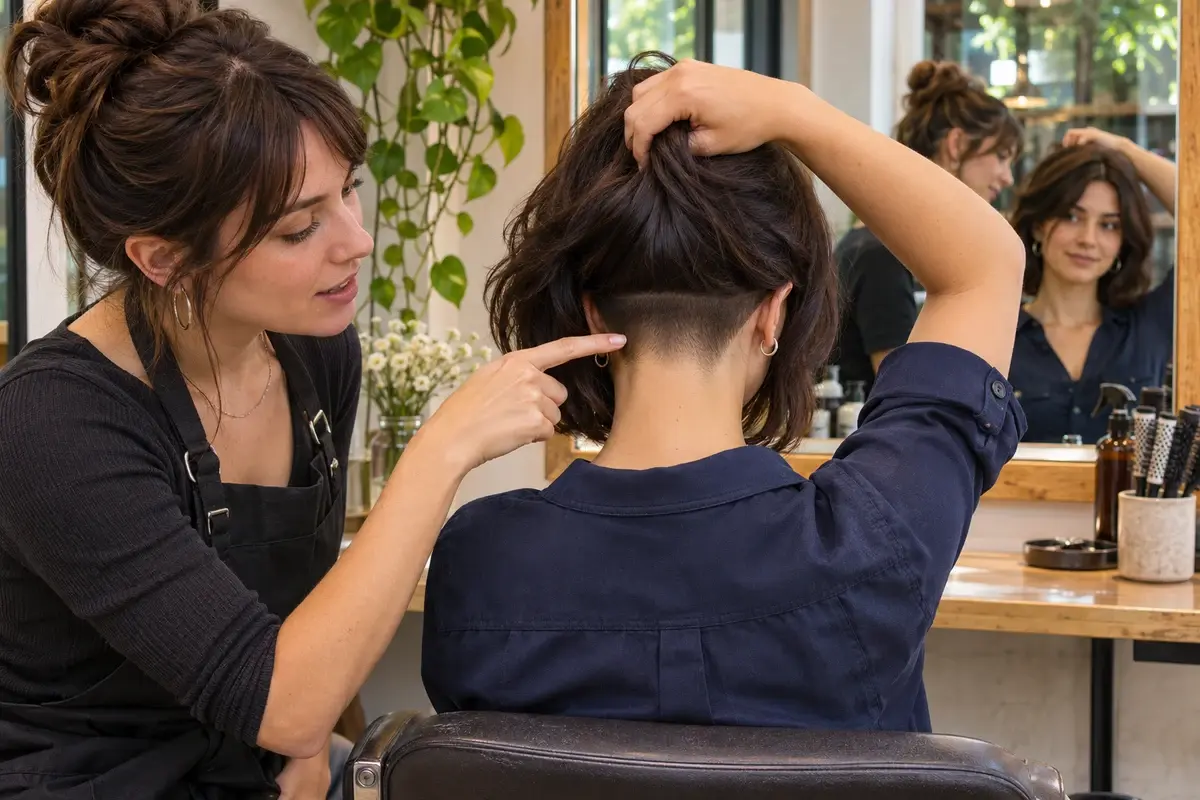
Step 1: Name the job of the clipped section
An undercut leaves a deliberately shorter area beneath longer hair. Decide whether you want a visible contrast, less hair at the nape, or a concealed detail that appears only when you lift your hair. Those are different briefs. A nape section is not interchangeable with a shaved side.
Write a goal and a limit: “I want an exposed nape when I tie my hair up, but no clipped area visible beside my ears when it is down.” If your only concern is a heavy outline, first compare the thick-hair haircut options and layer decision guide. A stylist may propose an alternative that preserves more length.
Do not assume an undercut is required by your hair type. Removing a section changes the distribution of remaining hair, not biological density or strand diameter. Your output is one specific reason for clipping rather than a general request to make hair easier.
Step 2: Test coverage in your everyday styles
At the consultation, ask the stylist to separate the proposed section without cutting. Look from behind and both sides with the remaining hair loose, tucked, and tied as you normally wear it. Change to your alternate part. Take photographs with permission so you can see the nape rather than relying on a front mirror.
Coverage in one still position does not establish concealment during movement. Ask what may show when you bend forward or lift an arm. A smaller section is the more cautious discussion point if keeping it covered matters, but your actual distribution and length determine what is possible.
For fine or lower-density hair, ask specifically how much perimeter fullness would remain. Schwarzkopf’s undercut explanation cautions that shaving a section may be unsuitable when little hair remains to cover it; treat that as a practical consultation concern, not a ban on a hair type. Record which positions expose the section and whether that exposure is welcome.
Step 3: Compare upkeep and the exit plan
A clipped boundary and a long perimeter have different jobs. Decide whether you prefer a crisp division or are comfortable letting the short area soften. Ask the stylist to show the length they mean rather than choosing a clipper number from an unrelated photograph.
Growing out means living with a short section under or beside longer hair until you choose to blend it or retain the contrast. There is no universal appointment interval that suits every boundary. Ask when to reassess based on the outline you care about, and who will maintain it.
| Priority | Question before clipping | Tradeoff to accept |
|---|---|---|
| Concealment | Does the remaining hair cover this area in both parts? | Movement may reveal it |
| Visible contrast | Which edge should be visible from the side? | The edge becomes a maintenance focus |
| Less nape hair | Could a smaller area achieve the goal? | More clipping changes the eventual grow-out |
| Easy exit | How would we blend the short area later? | Intermediate lengths may need a different outline |
Your output is a maintenance preference and one acceptable intermediate style. If you dislike every exit option, wait.
Step 4: Confirm the boundary before the service
Ask the stylist to show the upper edge, side limits, remaining cover length, and intended short length on your own head. Keep the hair separated while you check a rear mirror. Do not approve a larger section just because a reference looks dramatic.
Use this brief: “Clip only [area], stopping at [visible boundary]. Preserve [cover lengths]. I accept exposure when [activity], but want coverage when [activity]. My upkeep preference is [crisp or softened]. If I grow it out, I would consider [intermediate shape]. Please explain what my growth patterns change.”
The stylist should choose the technique and adapt the plan to your hairline, density, texture, and scalp. If you have irritation or scalp symptoms, discuss them before clipping and seek appropriate healthcare advice rather than using a short section to address an unexplained problem. Leave with a shared boundary, not only the word undercut.
Common mistakes
Approving from the front mirror alone misses the defining section. Choosing the highest boundary first makes a concealed detail harder to preserve. Assuming all remaining hair will fall the same way ignores parting and movement. Treating clipping as a remedy for shedding confuses a shape choice with a healthcare concern.
Compare outlines with Hair Fairy
After completing the independent plan, use Hair Fairy Custom Style with a reference image, a written description, or both. Compare a concealed nape detail with an unclipped outline, holding length above the section, texture, color, portrait, and part constant. A front-facing result may not show the nape at all; discard it as evidence of that boundary. Reject any result that changes your face or adds cover hair you do not have. A preview cannot measure your hair, predict natural behavior, select cutting technique, confirm feasibility, or guarantee a salon result. Review the photo privacy policy before uploading. Take your finalists and remaining questions to a hairstylist.
Decision summary
Choose an undercut when its placement serves a specific goal, its exposure works in your everyday styles, and both upkeep and intermediate lengths feel acceptable. If concealment is uncertain, discuss a smaller section or retain the length until an in-person sectioning check resolves it.
Frequently Asked Questions
Questions about choosing and maintaining a haircut
Is an undercut always visible?
No. Visibility depends on placement, remaining cover length, part, movement, and how you tie your hair. Check those positions with a stylist before clipping.
Will an undercut make my hair thinner?
It removes length from one section and changes visible coverage. It does not change the biological diameter of strands or the number of follicles.
Can I keep an undercut hidden at work?
Possibly, but one still photograph cannot establish concealment. Test your work styles and movement and accept that the section may show.
How often should I maintain it?
Ask your stylist to agree a reassessment point based on whether you want a crisp boundary or accept a softer growing section. There is no single useful interval for every design.
How do I grow an undercut out?
Decide whether to retain the contrasting section while it gains length or reshape the longer hair toward a blend. Agree an intermediate outline with a stylist.
Can a preview show the undercut boundary?
Only if the relevant area is visible, and even then it is a visual reference. An in-person sectioning check is needed to evaluate coverage and feasibility.
About This Guide
Diane BennettBlog author, Hair Fairy
Diane Bennett writes Hair Fairy guides about haircut decisions, everyday hair routines, and preparing clear questions for a hairstylist.
Haircut comparison, salon planning, and responsible use of visual hairstyle previews.
View author profileSee us more often in Google
One click marks Hair Fairy as a preferred source, so our articles are more likely to appear in your Top Stories, and can show a preferred badge in AI Mode and AI Overviews.
Compare Your Idea
Preview a hairstyle on your own photo.
Use a reference, a written description, or both—then discuss the practical result with your stylist.