
Salon Planning
How to Plan a Haircut Before Your Wedding
Coordinate a haircut with your wedding hair trial, updo requirements, accessories, and final shape check without relying on a universal week count.
Plan a haircut before your wedding by choosing the ceremony hairstyle first, identifying the lengths it needs, testing any meaningful cut before confirming the style, and agreeing on a limited final tidy. Set the dates with your haircut and wedding stylists. Leave room for a review instead of assuming one week count fits every cut.
Key Takeaways
- Choose the event arrangement before removing the lengths that support it.
- Test a meaningful shape change with enough time to review it before the wedding.
- Record which sections a final tidy may shorten and which should stay.
Step 1: Choose the ceremony arrangement first
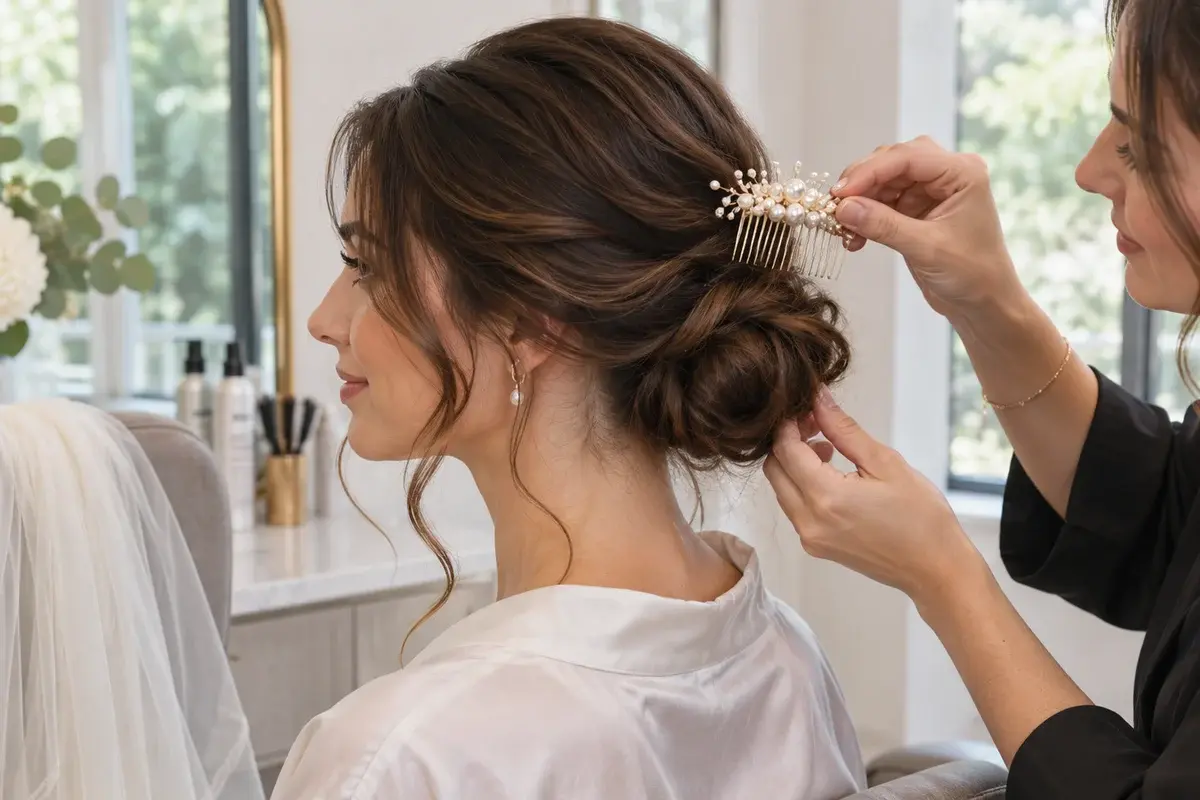
Decide whether you want hair loose, partly pinned, or fully secured. Save one main reference and one realistic alternative. Include the neckline and any veil or hair accessory in the conversation: the haircut should support the arrangement you plan to wear, not an unrelated inspiration photo.
A wedding style is a constructed finish. Sam Villa's professional up-styling education explicitly includes foundations and support through setting, braiding, and backcombing. That is why “keep it long” is less informative than asking which sections the particular arrangement needs.
Output: one ceremony direction and one backup. If you prefer a short cut worn loose, record the desired outline rather than planning around an updo you do not want.
Step 2: Identify the sections the style depends on
Ask your wedding stylist to show which pieces need to reach the bun, roll, braid, clip, or other fastening point. Check the front pieces separately: you may want them left out, tucked, or secured. A long back does not establish that the front will reach.
Use trial photos from both sides and behind to record what was tucked or pinned. If you have not had a trial yet, share the proposed haircut before booking it. The ponytail-preservation guide explains the same section-by-section reasoning for everyday tie-back needs, though a wedding arrangement needs its own professional check.
| Section | Question for the wedding stylist | Note for the haircut stylist |
|---|---|---|
| Front pieces | Should these stay out or reach a fastening point? | Shortest permitted dry endpoint |
| Sides | Which pieces cover or join the support? | Areas to preserve until the trial |
| Back | How much length does the chosen arrangement use? | Maximum agreed removal |
| Fringe | How will it sit with the accessory? | Existing shape to maintain or change |
Output: a protected-length note. If extensions are part of your plan, ask the professionals to check the actual pieces together; a reference image cannot confirm the match or support.
Step 3: Schedule a meaningful change before the final trial
Separate a new shape from maintenance of a familiar one. Removing substantial length, adding a fringe, or changing the front layers creates questions that a small perimeter tidy may not. Give a new shape a chance to be worn, washed in your ordinary routine, and tested in the event arrangement before you consider that arrangement settled.
For example, plan in this order: consultation about the proposed cut, agreed shape change, event styling trial, review of anything that failed, then confirmation of the final plan. These are dependencies, not prescribed dates. Ask your stylists to place them on your calendar with time available for a further appointment if needed.
Do not assume that waiting a fixed number of days makes an unwanted short section long enough. If the wedding is close and the trial works, preserving the confirmed shape is a practical option. If you want a dramatic change regardless of the event, say so explicitly and revise the event style around it.
Output: dates for the cut, trial, and review, plus a decision about what can wait until afterward.
Step 4: Define the final tidy in writing
After a successful trial, save photos and specify what the final haircut may change. Replace “just tidy everything” with an agreed area and removal limit. Ask both stylists whether a small change would alter the fastening points or front pieces they approved.
Wedding haircut note: My event is [date]. My trial arrangement is [description]. Please preserve [sections and dry endpoints]. We agreed to tidy [area] only after discussing [removal limit]. My accessory sits [position]. If a larger change is suggested, I want to revisit the event plan first.
Use the hairstylist communication brief to add your normal routine and what you want after the wedding. You will still wear the haircut on ordinary days.
Output: a limited final service and a shared reference set, with any disagreements resolved before cutting.
Common mistakes
- Following a universal deadline without considering whether the cut is familiar or entirely new.
- Cutting the front shorter after a trial that relied on pinning those pieces back.
- Showing only the front of an updo when the haircut affects the back support.
- Making the wedding style the only requirement when you also want to wear the cut loose.
- Expecting a virtual image to prove that a veil or comb will stay in place.
Compare the loose cut with Hair Fairy
After identifying the event constraints, use Custom Style to compare the loose outline you want to live with. Hold the portrait, color, part, and texture direction constant and change one feature, such as front length. Discard images that change your face, add unrequested volume, or alter the back length without your request. Read the privacy policy before uploading.
A preview can support the haircut conversation. It cannot test an updo, accessory security, hair density, natural movement, or salon feasibility, and it cannot guarantee the wedding result. Take two preferred outlines and the real trial photos to the professionals; test the event arrangement on your actual hair.
Decision summary
Work backward from a hairstyle that has been tested with the needed lengths. Make a substantial haircut change early enough to review the event style afterward. Once the trial works, protect its supporting sections and define any final tidy precisely. Your stylists can then schedule appointments around your actual plan.
Frequently Asked Questions
Questions about planning your haircut
How many weeks before my wedding should I cut my hair?
There is no single interval for every cut. A new shape needs time for a trial and review, while a familiar perimeter tidy can follow a plan agreed with your stylists. Use your own experience of the cut rather than a generic deadline.
Should I cut my hair before or after the wedding hair trial?
Tell both stylists about the planned cut. If it changes lengths needed for the wedding style, test the intended shape before treating the trial as final. A later small tidy should stay within the boundaries established at the trial.
Can I add bangs just before my wedding?
You can choose bangs, but a late first attempt leaves less opportunity to test styling and accessories. Try the direction earlier or postpone it if preserving the confirmed ceremony look is your priority.
Do I need long hair for a wedding hairstyle?
No. Choose an arrangement that works with your chosen length. Ask the wedding stylist what support, pins, or accessories the specific look needs rather than growing hair for an assumed rule.
What should I bring to the haircut appointment?
Bring trial photos from several angles, the event date, a note about accessories, and the protected lengths agreed with the wedding stylist. Explain whether you also need the cut to work loose.
About This Guide
Diane BennettBlog author, Hair Fairy
Diane Bennett writes Hair Fairy guides about haircut decisions, everyday hair routines, and preparing clear questions for a hairstylist.
Haircut comparison, salon planning, and responsible use of visual hairstyle previews.
View author profileSee us more often in Google
One click marks Hair Fairy as a preferred source, so our articles are more likely to appear in your Top Stories, and can show a preferred badge in AI Mode and AI Overviews.
Compare Your Idea
Preview a hairstyle on your own photo.
Use a reference, a written description, or both—then discuss the practical result with your stylist.