
Salon Planning
How to Tell Your Hairstylist What You Want: A 4-Part Brief
Prepare for a haircut consultation with a clear four-part brief covering references, priorities, routine, length, and the plan you agree on.
 Hair Fairy Editorial8 min read
Tell your hairstylist what you want by bringing two or three focused references, naming what you want to keep and change, describing how you actually style your hair, and confirming the length and overall plan together before cutting begins. You do not need technical salon vocabulary; specific visual details and practical limits are more useful.
Key Takeaways
- Give every reference a purpose, such as showing the length, bangs, layers, texture, or back shape you want to discuss.
- Use a keep, change, avoid, and routine brief so your hairstylist can separate your priorities from the details you do not want copied.
- Confirm the shortest acceptable length, maintenance tradeoffs, and agreed direction before the haircut starts.
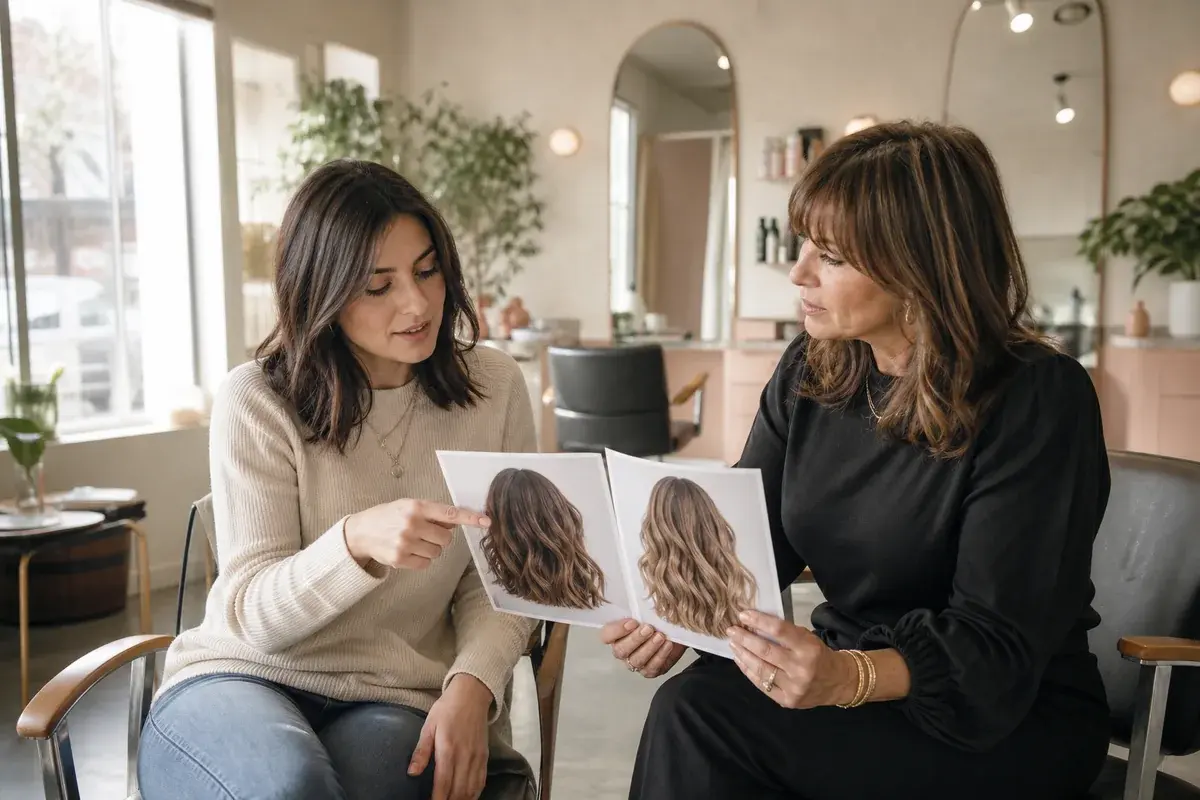
A useful salon conversation describes the result you want and the life that haircut needs to fit. It does not require you to diagnose your hair or direct the cutting method. Your hairstylist needs clear priorities, honest routine information, and room to adapt the idea to your hair.
Step 1: Bring two or three focused references
Choose a small set of images before the appointment. In Woman & Home’s reference-photo guidance, hairstylist Michael Douglas recommends two or three images rather than relying on one. Multiple references can separate the elements you like: perhaps the length from one, the bangs from another, and the everyday texture from a third.
Give every image a job:
- Overall shape: the closest example of the finished silhouette.
- Detail: a clear view of the bangs, face framing, perimeter, or layers.
- Realistic finish: an example with texture or density relevant to your hair and routine.
The model does not need to resemble you. Concentrate on whether the hair feature is visible. A front view may explain bangs but hide the back; a side or three-quarter view can fill that gap.
Use the reference-photo selection guide to reduce a large inspiration folder to an annotated set. If you are still deciding among haircut families, browse the women’s hairstyle directory first.
Step 2: State what to keep, change, and avoid
Do not hand over a photo and assume its meaning is obvious. Name the detail you want from it and the details you do not. The same image may contain a haircut you like, a color you do not want, more styling than you will do, and a length that only looks shorter because it is curled.
Use plain, visible language. The British Council’s haircut vocabulary guide distinguishes a vague trim request from naming a more specific amount. The point is not to memorize jargon; it is to replace ambiguous words with observable boundaries.
| Vague language | More useful language |
|---|---|
| “Just a trim” | “Keep the overall length and remove only what we agree is needed at the ends.” |
| “I want layers” | “I want movement through the lower half, but I need the front pieces to reach my ponytail.” |
| “Make it lighter” | “I like the movement in this photo, but I want to keep visible fullness at the perimeter.” |
| “Not too short” | “The shortest point I am comfortable with is at my collarbone when dry.” |
| “I want these bangs” | “I like the soft center opening, but I do not want the sides shorter than my cheekbones.” |
| “Do whatever you think” | “I am open to your adaptation, but keeping tie-back length is my priority.” |
An avoid example can be as useful as an inspiration image. Point to the exact part you dislike rather than labeling the whole haircut bad. That keeps the discussion factual and gives your hairstylist a boundary to work with.
Step 3: Explain your real routine
Describe what happens after you leave the salon. Burman & Co’s consultation guide emphasizes sharing the time and effort you actually spend on your hair, rather than an ideal routine. A haircut shown after a professional blowout may behave differently when air-dried, diffused, tied back, or worn through humid weather.
Tell your hairstylist:
- whether you air-dry, diffuse, blow-dry, straighten, curl, or alternate
- how many minutes you normally spend styling
- which products or tools you are comfortable using
- whether work, exercise, sleep, or caregiving makes tie-back length important
- what your hair does around the part, crown, hairline, and ends
- whether you prefer a precise outline or a forgiving grow-out
- how often you realistically want the shape reassessed
If you are trying to reduce daily or salon work, compare the tradeoffs in the low-maintenance haircut guide. If appointment timing is your main concern, use the haircut scheduling guide as a starting point, then adjust it with your hairstylist.
Step 4: Confirm the length and plan
Before cutting begins, turn the conversation into a shared plan. Show the target length on your own hair rather than only on the reference model. Then state the shortest point you would still feel comfortable wearing. This matters because curled, stretched, wet, dry, and styled hair can appear at different lengths.
Ask your hairstylist to summarize:
- the dry visual length and perimeter you are aiming for
- the main areas that will gain or lose visible weight
- how the front, bangs, or face-framing pieces will connect
- what the cut is expected to do with your normal finish
- the maintenance or grow-out tradeoff you are accepting
This confirmation is a checkpoint, not an instruction about professional technique. If the stylist recommends changing the plan, ask which constraint the change addresses and what alternative would preserve your highest priority.
Your copyable consultation brief
Copy this into your notes and fill it in before the appointment:
GOAL: I want my haircut to feel [shorter / more defined / softer / more movable / easier to tie back].
KEEP: Please preserve [current color / overall length / perimeter fullness / bangs / tie-back ability].
CHANGE: I want to change [length / outline / face framing / bangs / layer movement / part].
AVOID: I do not want [a specific feature], especially because [practical reason].
ROUTINE: I usually [air-dry / diffuse / use a tool] for about [time], and I wear my hair [typical styles].
LENGTH LIMIT: The shortest visible point I am comfortable with is [location when dry].
REFERENCES: Photo 1 shows [feature]; photo 2 shows [feature]; photo 3 shows [feature].
QUESTION: How would you adapt this direction to my texture, density, growth patterns, and routine?
Salon consultation checklist
- I selected two or three focused references.
- I labeled what I want from each image.
- I separated haircut decisions from color and professional styling.
- I wrote down what to keep, change, and avoid.
- I described my actual drying, styling, and tie-back routine.
- I named my target length and shortest acceptable point.
- I asked about maintenance, grow-out, and practical adaptation.
- My hairstylist and I restated the plan before cutting.
Common communication mistakes
Asking for a feeling without a visible detail
Words such as fresh, edgy, soft, and effortless can mean different things. Pair the feeling with a length, shape, movement, or reference.
Treating one photo as a complete specification
One image may hide the back and depend on lighting, extensions, color, or styling. Use another angle and say what not to copy.
Using technical terms you are unsure about
Layer names and cutting terms can vary. Describe the effect you want and let the hairstylist select the method.
Describing an aspirational routine
A cut planned around daily heat styling will not serve the same way if you usually air-dry. Give the routine you are likely to maintain.
Leaving the minimum length unspoken
“Shorter” describes a direction, not a boundary. Point to the target and the shortest acceptable dry length.
Agreeing before the tradeoffs are clear
If a requested shape changes tie-back ability, styling work, or grow-out, decide whether that exchange supports your priorities before proceeding.
Use a preview as one reference
After your independent brief is clear, you can make one more visual with the reference-photo try-on guide. Hair Fairy Custom Style accepts a hairstyle reference, a written description, or both, so you can test the direction you plan to discuss. When you have several candidates, use the controlled comparison guide; before a major length change, complete the short-hair decision checks.
Keep the preview in context. Pair it with real-hair references and your written constraints. It can help show a preferred silhouette or length, but it cannot predict shrinkage, movement, maintenance, or what a stylist can achieve with your hair. Review the privacy policy before uploading a portrait.
Decision summary
Tell your hairstylist what you want with a small visual set and a practical four-part brief: references, keep/change/avoid priorities, real routine, and a confirmed length and plan. Be exact about the outcome and flexible about the professional technique. The goal is not to command the service; it is to make the decision legible before the haircut starts.
Frequently Asked Questions
Questions about planning your haircut
How many haircut references should I show my hairstylist?
Two or three focused references are usually enough. Give each image a clear purpose, such as showing the overall shape, front details, or back and side view.
Do I need to know technical haircut terms?
No. Describe visible outcomes such as where the length should end, what you want around your face, and how much daily styling you will do. Let your hairstylist translate those priorities into technique.
Can I show a photo of a haircut I do not want?
Yes. A disliked example can clarify a boundary when you point to the exact feature you want to avoid, such as a heavy bang, short crown layer, or exposed nape.
What should I say about maintenance?
Explain whether you air-dry or use tools, how much time you normally spend styling, whether you tie your hair back, and how often you realistically want salon reshaping.
How can I confirm the haircut length before cutting?
Show the desired endpoint on your own hair and name the shortest length you would accept. Ask your hairstylist to restate the agreed perimeter and how shrinkage or styling may affect where it appears.
Can I use an AI hairstyle preview at my appointment?
Yes. Treat it as one visual reference and pair it with real-hair examples. A preview can communicate direction, but it cannot predict how your natural hair will behave or guarantee the salon result.
About This Guide
Hair Fairy EditorialEditorial team, Hair Fairy
Hair Fairy Editorial writes and reviews Hair Fairy guides with a focus on realistic haircut decisions, clear salon communication, and styles that work beyond the inspiration photo. The team balances visual ideas with texture, maintenance, and everyday wear.
Women’s haircut selection, face-shape and texture considerations, salon-reference planning, maintenance trade-offs, clear stylist communication, and responsible use of AI hairstyle previews as decision aids rather than guarantees.
View author profileSee us more often in Google
One click marks Hair Fairy as a preferred source, so our articles are more likely to appear in your Top Stories, and can show a preferred badge in AI Mode and AI Overviews.
Compare Your Idea
Preview a hairstyle on your own photo.
Use a reference, a written description, or both—then discuss the practical result with your stylist.