
Haircut Decision Guides
How to Grow Out Bangs: 4 Steps for a Wearable Transition
Grow out bangs with a clear length goal, comfortable ways to keep hair out of your eyes, a selective salon plan, and progress checks in your usual texture.
Grow out bangs by choosing the dry length you want to reach, finding a comfortable way to keep the current fringe out of your eyes, agreeing which sections a stylist may reshape, and checking progress in your usual texture. Preserve the sections that need length rather than repeatedly cutting a new short fringe; choose an intermediate side sweep or open fringe only if it fits your actual routine.
Key Takeaways
- Define success by a useful dry endpoint, such as an ear tuck or connection to face framing, rather than a promised completion date.
- A clip, open fringe, or side sweep can bridge the transition without requiring the whole haircut to change.
- Tell your stylist which front sections need to gain length and what can be adjusted without resetting that goal.
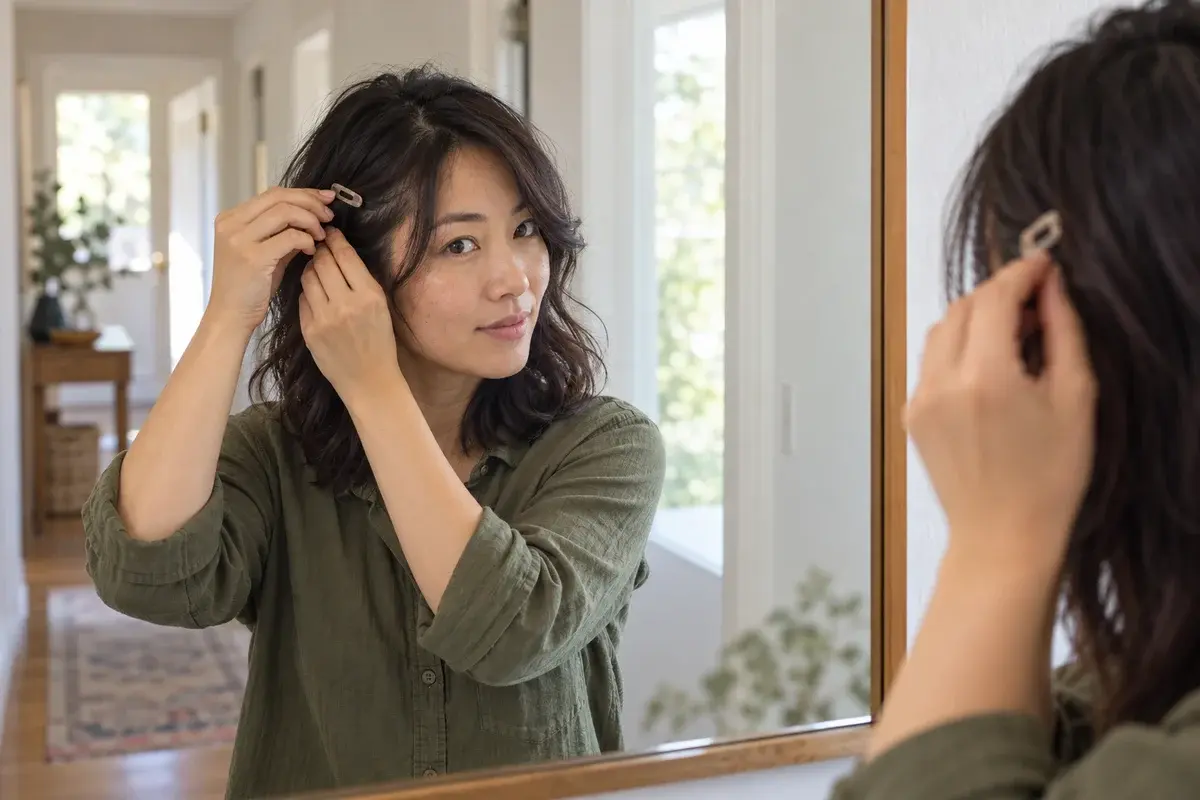
Growing out bangs creates a small but very noticeable transition: the front may stop behaving like a fringe before it reaches the rest of the haircut. The useful question is what to wear during that interval. This guide helps you plan that bridge; use the bang-selection guide if you are still deciding whether to keep a shorter fringe instead.
Step 1: Set a useful dry length goal
Decide what you want your front hair to do. “No bangs” might mean hair that stays out of your eyes, reaches a comfortable ear tuck, joins cheekbone framing, or eventually reaches a ponytail. Those are different endpoints, with different intermediate arrangements.
Look at the fringe after your normal drying method. Note the shortest central piece, the longer side pieces, any lifting at the roots, and where the ends land without stretching. For curls or waves, keep the usual pattern intact for this check. A wet or straightened measurement is useful context, but it is not the finish you wear every day.
Write a target and an acceptable bridge:
My front hair should eventually [tuck behind my ears / join my jaw-length framing / reach my low ponytail]. Until then, I can wear [a side clip / an open fringe / a side sweep].
Take a front and side photo with your head upright. These become your starting record. Avoid promising yourself a date based on somebody else's fringe; the distance to your target matters as much as the starting haircut.
Output: one visible endpoint and two starting photos.
Step 2: Choose a comfortable intermediate arrangement
Try the simplest arrangement that solves the current problem. Check it while reading, looking down, walking, and wearing glasses if relevant. A side sweep that looks good for a photo but repeatedly enters your eyes does not meet the same need as a secure clip.
| Intermediate choice | Useful when | Tradeoff to check |
|---|---|---|
| Small side clip | The section reaches a comfortable holding point | Slipping, pressure, or hair pulled tightly at the roots |
| Soft side sweep | The fringe already falls diagonally | Whether it stays clear of your eyes during movement |
| Open fringe | The center can separate comfortably | Root direction, side connection, and daily resetting |
| Loose headband | You want the front temporarily held back | Fit, pressure, and comfort through ordinary activity |
| Longer face framing | Front pieces are approaching a useful connection | Whether reshaping would remove length you still need |
These are options to test, not a mandatory sequence. You can stay with a clip until the fringe reaches your next milestone. A side sweep also need not become a newly cut side fringe: first try arranging the existing length. The side-swept bangs and curtain bangs examples can help you describe a direction, not establish that your current length is ready for it.
Avoid tight pulling to force a short section backward. The American Academy of Dermatology's guidance on traction explains that repeated tension can cause hair loss and that a painful style is too tight. Loosen or remove an uncomfortable arrangement. Seek a dermatologist's advice for patchiness, sudden shedding, or persistent scalp symptoms rather than treating them as a fringe problem.
Output: one wearable arrangement and one backup for days it does not hold.
Step 3: Agree what to preserve and reshape
At the appointment, show the target before discussing a trim. Ask your stylist to identify the front sections that still need length and explain any proposed adjustment before cutting them.
Separate three decisions:
- Preserve: the shortest pieces whose extra length is necessary to reach your goal.
- Consider adjusting: an edge or side connection that prevents the interim arrangement from working.
- Leave independent: the rest of the haircut, unless it also needs a change.
For example, “I want the center to keep gaining length, but I am open to a small side adjustment if it helps it join the longer framing” gives a clearer boundary than “blend everything.” Blending can mean removing hair; ask where and how much. Do not prescribe a razor, thinning method, or cutting angle from a tutorial.
A professional may suggest a staged transition into face-framing layers. Compare the benefit of that connection with the length it would remove. If keeping every bit of front length is your priority, explain that you prefer temporary styling over a more finished outline. Use the hairstylist communication brief to record the agreed boundary.
Output: a preserve/adjust plan confirmed before scissors touch the fringe.
Step 4: Review progress without resetting the goal
Repeat the same photos when the fringe begins behaving differently: it clears an eye, holds in a clip, reaches a tuck, or connects with the sides. Keep the part, head position, and drying method similar enough to make the comparison useful. Compare what the section can do rather than judging tiny differences in a mirror each day.
At each review, ask:
- Does the present arrangement still work comfortably?
- Has a new milestone become possible without cutting?
- Would a proposed adjustment solve a specific problem, and what length would it remove?
- Is my original target still the one I want?
Use the haircut interval guide to discuss the rest of the shape separately. An appointment does not require returning your bangs to their old baseline.
If you use heat to arrange the fringe, follow the AAD's healthy-hair guidance: limit hot-tool use, select low or medium heat, and use heat protection. More heat is not a substitute for a wearable intermediate plan.
Output: keep the current bridge, move to the next one, or agree a specific salon adjustment.
Your bang grow-out brief
TARGET: I want the front to reach [dry endpoint or function].
PRESERVE: These [central / side] pieces still need length.
CURRENT PROBLEM: The fringe [enters my eyes / separates here / will not stay tucked].
INTERIM PLAN: I can maintain [arrangement] with [amount of daily effort].
BEFORE CUTTING: Please show which sections you would shorten and how that supports the target.
NEXT CHECK: We will reassess when [visible milestone or practical problem] changes.
Common bang grow-out mistakes
Recreating the original fringe at every visit. That may restore a neat short outline, but it removes the length you are trying to gain. Decide whether this appointment is maintenance or transition.
Treating curtain bangs as an automatic halfway stage. Your current fringe may not separate or connect like the reference yet. Compare the actual dry length and styling commitment first.
Cutting the whole front to match the shortest piece. Ask whether that serves your goal or expands the area that needs to grow.
Choosing a bridge that only works with constant pulling or restyling. Test normal movement and comfort before relying on it every day.
Using a preview as a growth forecast. A generated longer fringe does not establish when, or how, your hair will reach it.
Compare an intermediate fringe with Hair Fairy
After choosing the target and practical bridge, use Hair Fairy Custom Style with a reference image, written description, or both. Compare a longer open fringe with a side sweep on the same portrait, keeping the overall length, color, and texture direction constant. The controlled comparison guide explains how to compare one change at a time.
Reject a result that changes your face, shifts the hairline, erases your curl pattern, or shortens areas you asked to preserve. A preview can communicate the intended front outline. It cannot predict growth, natural fall, accessory comfort, cutting technique, feasibility, or a salon result. Review the privacy policy before uploading a portrait, then bring your preferred preview alongside current hair photos and the written brief.
Decision summary
Choose the next usable milestone, not a deadline for the entire transition. Keep the length that serves that milestone, use a comfortable interim arrangement, and approve only adjustments whose purpose you understand. When the front starts doing what you need, decide whether to keep that shape or continue toward the original endpoint.
Frequently Asked Questions
Questions about choosing and maintaining a haircut
How long does it take to grow out bangs?
It depends on the current length, the endpoint you want, your growth, any trimming, and how your hair sits when dry. Reaching an eye-clearing sweep is a different goal from joining jaw-length face framing. Use progress photos and a target on your own hair rather than a fixed deadline.
Should I trim bangs while growing them out?
Discuss a selective adjustment if the outline is uncomfortable or the ends need attention. Ask what would be removed and how that affects the target. Repeatedly shortening the central fringe to its old line conflicts with gaining length there.
Can blunt bangs become curtain bangs?
An open fringe can be an intermediate direction, but the center length, side connection, density, growth pattern, and styling effort need assessment. Do not assume a reference photo can be copied immediately or that opening the fringe requires shortening its center.
What can I do when bangs keep falling into my eyes?
Try a comfortable side placement or a small clip that holds the section without pulling. If neither works in your everyday routine, ask a stylist about a limited adjustment and agree which length to preserve before cutting.
How should I grow out curly bangs?
Track the fringe in its normal dry curl pattern and choose an interim shape with a stylist. A stretched section does not show its everyday endpoint. Preserve the curl length you need and avoid using a straight-haired example as a schedule or cutting instruction.
Can an AI preview show how my bangs will grow?
No. A preview can illustrate a preferred side sweep or longer face frame, but it cannot forecast growth, curl behavior, clipping comfort, or the time needed. Use it beside current hair photos and a salon plan.
About This Guide
Diane BennettBlog author, Hair Fairy
Diane Bennett writes Hair Fairy guides about haircut decisions, everyday hair routines, and preparing clear questions for a hairstylist.
Haircut comparison, salon planning, and responsible use of visual hairstyle previews.
View author profileSee us more often in Google
One click marks Hair Fairy as a preferred source, so our articles are more likely to appear in your Top Stories, and can show a preferred badge in AI Mode and AI Overviews.
Compare Your Idea
Preview a hairstyle on your own photo.
Use a reference, a written description, or both—then discuss the practical result with your stylist.