
Haircut Decision Guides
How to Choose a Bob Haircut: 4 Steps
Choose a bob by setting the dry length, comparing perimeter and layering, checking hair behavior, and preparing a clear salon brief.
 Diane Bennett7 min read
Choose a bob haircut by setting the shortest comfortable dry endpoint, deciding whether you want a blunt, layered, or angled perimeter, checking how your texture, density, part, nape, and routine will affect that shape, and taking one preferred bob plus a less-committed fallback to a hairstylist. The strongest starting point is usually a bob or lob length that preserves your highest practical priority while making the intended outline clear.
Key Takeaways
- “Bob” describes a length family, not one cut; endpoint, perimeter, graduation, layers, part, and fringe all change the result.
- Choose the dry outline before debating technique, and check nape growth, shrinkage, shoulder contact, and tie-back needs.
- Bring a preferred bob and a longer fallback with front, side, and back references so a hairstylist can adapt the structure.
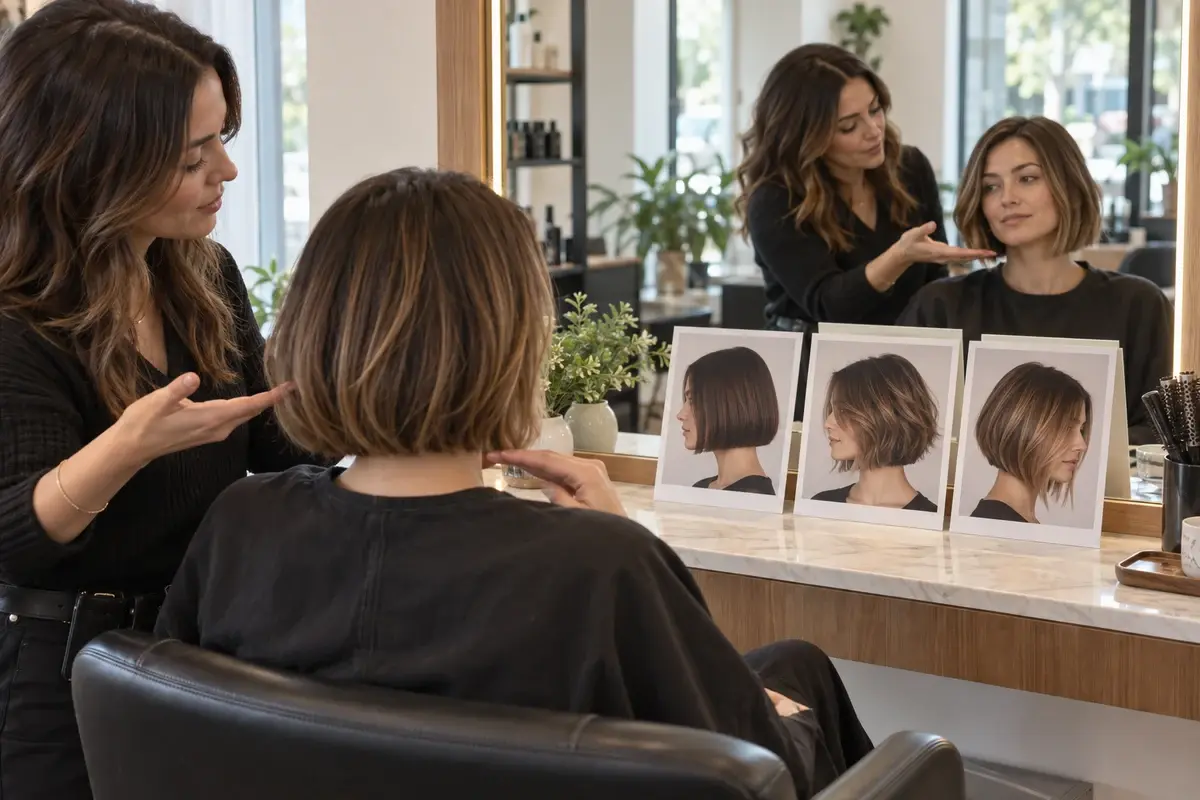
A bob can end at the jaw, chin, upper neck, shoulders, or collarbone and can be blunt, graduated, angled, or layered. Decide the visible structure before choosing a fashionable label.
Step 1: Set the dry length and commitment
Stand in front of a mirror with your hair dry in its ordinary finish. Mark three possible endpoints with your hand:
- around the jaw or chin
- through the upper or lower neck
- near the shoulders or collarbone
For each, check face and neck exposure, whether the front can tuck behind the ears, and whether any of the hair can be tied back. Curly or wavy hair may finish at a different point when dry, while straight hair may show a precise edge more clearly. The short-hair decision guide can help if the change feels larger than the choice between bob variants.
Write two boundaries:
My preferred dry endpoint is [landmark]. The shortest point I would still accept is [landmark].
Output: a target length and a firm lower boundary.
Step 2: Choose the perimeter and movement
Now decide what the outline should do. Professional haircut education commonly distinguishes solid, graduated, and layered forms as different foundations rather than interchangeable names (Pivot Point educational catalogue). You do not need to prescribe the technique; use the distinction to describe the result.
| Bob direction | Visible result | Main tradeoff |
|---|---|---|
| Blunt bob | Strong, continuous lower edge | Precision can show growth quickly |
| A-line bob | Front appears longer than the back | The angle and nape require clear agreement |
| Layered bob | More separation and movement | Too much layering may weaken the perimeter |
| Shaggy bob | Broken outline with visible texture | Less polished edge and fewer solid sections |
| French bob | Compact chin-area shape, often with fringe | Short length and fringe increase commitment |
| Shoulder-length lob | Longer bob family with broader flexibility | Shoulder contact can redirect the ends |
Choose one main direction and one element you want to avoid. For example: “I want a strong edge with no short crown layers,” or “I want movement but still need a visible perimeter.”
Output: one perimeter choice and one preservation rule.
Step 3: Test the bob against your hair and routine
Evaluate the proposed shape against what your hair does, not only the styled reference.
- Texture and shrinkage: Where does the hair finish fully dry?
- Density and strand diameter: How much visual weight do you want at the edge?
- Growth patterns: Does the nape, crown, or front hairline push in a strong direction?
- Part and fringe: Will you keep the part, change it, or add bangs?
- Routine: Will you air-dry, diffuse, blow-dry, straighten, or alternate?
- Practical use: Do you need to tuck, tie, exercise, wear a headset, or use glasses?
- Commitment: How important is a precise outline as the cut grows?
Hair curvature exists on a continuum, so a bob shown on one texture does not predict the resting shape on another (International Journal of Cosmetic Science). If a reference depends on frequent heat styling, remember that the American Academy of Dermatology advises limiting high heat to reduce damage (AAD).
Use the bangs guide and layers guide only after the base length and perimeter are settled.
Output: a behavior and routine note that may change the first choice.
Step 4: Build a two-option salon brief
Collect two or three views of your preferred bob and a longer fallback. The fallback should keep the same design idea with less commitment: a collarbone lob instead of a chin bob, a lightly layered bob instead of a shaggy bob, or a longer A-line instead of a sharply exposed nape.
Label every image:
- the exact feature you want from it
- the dry endpoint you mean
- what should remain fuller or continuous
- whether the part, fringe, color, and styling are relevant
- which feature you do not want copied
Then ask the hairstylist how the shape should change for your texture, density, nape, and normal drying method. Use the consultation brief to confirm the plan before cutting.
Output: one preferred bob, one longer fallback, and a labeled reference set.
Bob decision worksheet
| Decision | Your answer |
|---|---|
| Preferred dry endpoint | |
| Shortest acceptable point | |
| Perimeter direction | |
| Desired movement | |
| Part or fringe plan | |
| Nape or hairline note | |
| Tie-back or tucking need | |
| Normal drying method | |
| Feature to preserve | |
| Longer fallback |
Common bob decision mistakes
Choosing by a name alone
“French bob,” “Italian bob,” and similar labels can refer to different lengths and finishes. Point to visible structure.
Deciding from the front only
A bob’s side line, back shape, and nape are essential. Bring angles that answer those questions.
Ignoring the dry endpoint
Wet, stretched, curled, and styled hair can finish at different places. Set the boundary in the state you normally wear.
Adding bangs and layers before choosing the base
Set length and perimeter first so the front and internal movement support one coherent silhouette.
Assuming shorter means less work
A bob removes length but may make the edge, nape, part, or sleep movement more visible. Compare daily styling with salon reshaping separately.
Copying a finish instead of the cut
Round-brushed volume, waves, or tucked ends can obscure the underlying structure. Include at least one reference where the perimeter is visible.
Compare bob directions with Hair Fairy
After the worksheet is complete, compare a blunt bob, layered bob, and shoulder-length lob on the same portrait. Hold color and unrelated styling details constant. Use Custom Style to describe a specific dry endpoint or combine a reference with written exceptions.
Reject any preview that changes your face, hairline, texture direction, or requested length incorrectly. A generated image can clarify a visible preference; it cannot inspect your nape, measure density, predict shrinkage, choose technique, or guarantee execution. Review the privacy policy before uploading a portrait.
Decision summary
Choose a bob by making four decisions in order: dry endpoint, perimeter and movement, fit with actual hair and routine, and a two-option salon brief. The strongest choice is the shortest version that still preserves your highest practical priority. Let a hairstylist adapt the structure while you stay specific about the visible result.
Frequently Asked Questions
Questions about choosing and maintaining a haircut
How do I choose the right bob haircut?
Start with the shortest dry length you want, then choose a solid, layered, or angled outline and compare it with your texture, density, growth patterns, routine, and tie-back needs. A hairstylist can adapt the technical structure.
What is the difference between a bob and a lob?
A bob usually ends between the jaw and upper neck, while a lob extends toward the shoulders or collarbone. Exact labels vary, so point to the intended dry endpoint rather than relying on the name alone.
Is a blunt or layered bob easier to maintain?
It depends on your hair and desired finish. A blunt bob has a simple shape but its precise edge can show growth; a layered bob may support movement but shorter sections can need more styling or a different grow-out plan.
Can thick or curly hair have a bob?
Yes. The perimeter, internal shape, dry length, expansion, shrinkage, and density distribution need individual adaptation. A reference with similar hair behavior is more useful than a rigid texture rule.
Should a bob sit above or below the chin?
Choose according to the amount of face and neck exposure, nape behavior, tie-back ability, and visual line you want. Compare both positions on your own references and state the shortest acceptable dry point.
Can an AI preview choose my best bob?
No. It can help compare visible lengths and outlines, but it cannot inspect density, nape growth, shrinkage, cutting technique, maintenance, or feasibility. Use it to prepare questions for a hairstylist.
About This Guide
Diane BennettWomen’s Hairstyle Editor, Hair Fairy
Diane writes and reviews Hair Fairy guides with a focus on realistic haircut decisions, clear salon communication, and styles that work beyond the inspiration photo. Her approach balances visual ideas with texture, maintenance, and everyday wear.
Women’s haircut selection, face-shape and texture considerations, salon-reference planning, maintenance trade-offs, clear stylist communication, and responsible use of AI hairstyle previews as decision aids rather than guarantees.
View author profileSee us more often in Google
One click marks Hair Fairy as a preferred source, so our articles are more likely to appear in your Top Stories, and can show a preferred badge in AI Mode and AI Overviews.
Compare Your Idea
Preview a hairstyle on your own photo.
Use a reference, a written description, or both—then discuss the practical result with your stylist.