
Haircut Decision Guides
How to Choose a U-Shaped or V-Shaped Haircut: 4 Checks
Compare U-shaped and V-shaped haircuts by back outline, shortest side length, visible fullness, texture, and the changes needed to return to a straighter edge.
Choose a U-shaped or V-shaped haircut by comparing the back outline, setting the shortest side length you will accept, checking how much visible fullness remains at the ends in your usual texture, and agreeing the return path with your stylist. A shallow U is a useful starting point for a broad curved edge; choose a V when a more pointed center matters enough to accept shorter sides and a narrower longest section.
Key Takeaways
- U and V describe the outer back outline; they do not specify every layer or the amount of face framing.
- Agree on the shortest side endpoint as well as the longest center point before cutting.
- A front-facing preview cannot verify the back perimeter, end fullness, or the length needed to change the shape later.
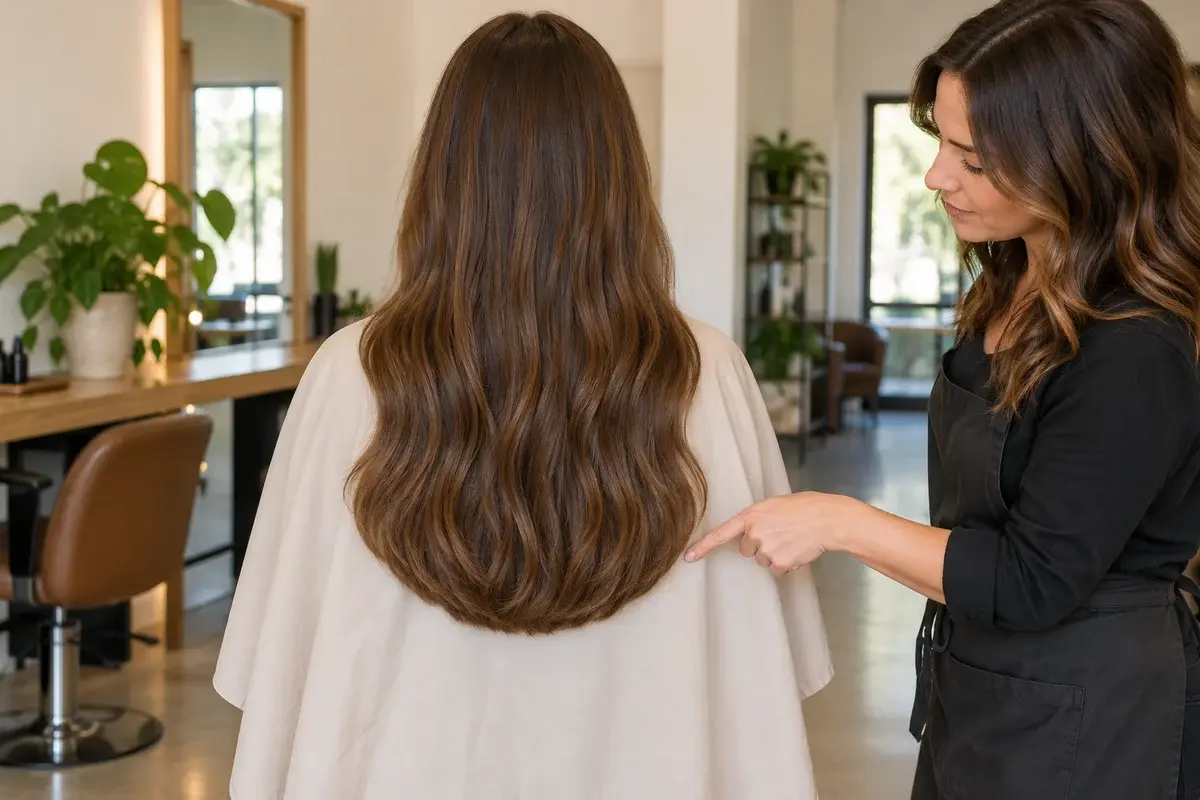
You can keep a long center section while changing a surprising amount of hair at the sides. That is the decision hidden inside many U-cut and V-cut references. Before choosing, compare how the whole lower edge should look and which lengths you are willing to give up. Use the broader haircut decision guide if you have not yet settled on keeping a longer shape.
Step 1: Compare the back outline separately from layers
A perimeter is the outside edge of the haircut when the hair falls into place. For this comparison, look at the bottom outline from behind: a U forms a rounded curve; a V narrows toward a center point. L'Oréal Professionnel artist Madison Sullivan describes those differences in Hair.com's U-cut and V-cut explanation. Use that as terminology, not a rule that either letter suits a particular person.
The letter does not tell you everything inside the outline. A reference may combine its back edge with short layers, long layers, front framing, a blowout, or curled ends. Separate those features before asking for the whole picture. Pivot Point's explanation of haircut structures describes length arrangements as the basis of haircut form; the important consultation point is to discuss the interior lengths as well as the outside line.
Save one U reference and one V reference with the hair down, the head upright, and the bottom edge unobstructed. Avoid comparing a curled U with a straightened V if you are trying to judge the perimeter alone.
| Outline to compare | Visible feature | Main decision |
|---|---|---|
| Shallow U | Broad rounded edge with a small center-to-side difference | How much curvature you want while retaining side length |
| Deeper U | More pronounced curve with longer center hair | Whether the shorter sides still meet your practical needs |
| Soft V | Taper toward a point with a gentler angle | How pointed you want the back without a very steep change |
| Deep V | Narrower longest center with a larger side-length difference | Whether the dramatic point is worth removing more side length |
| Straighter edge | More nearly level bottom outline | Whether retaining width across the ends is your priority |
These are descriptive comparisons, not standardized measurements. Two stylists may use the same name for different depths.
Output: two back-view references with the desired curve or point marked in your notes.
Step 2: Set both the center and side lengths
“Keep my length” is incomplete if it refers only to the longest point. Show your stylist where the center should finish when dry, then identify the shortest acceptable side endpoint. Both limits belong in the plan.
Bring the hair forward in the way you normally wear it and notice what changes. Do you want the sides to remain visible over both shoulders? Do they need to stay in a braid or ponytail? A long back point does not automatically preserve those functions. Use the ponytail-preservation checks if tie-back ability is essential.
Ask your stylist to show the proposed relationship on your own hair before cutting. Compare a shallower version first if the reference would shorten the sides beyond your limit. If the two limits do not leave room for the requested depth, revise the outline rather than quietly sacrificing one boundary.
Example:
I want a rounded back edge with the center near mid-back, but the side perimeter should stay below my collarbone when dry. If the reference needs shorter sides than that, please show a shallower curve.
Output: a center endpoint, a side minimum, and the function both need to preserve.
Step 3: Check end fullness in your normal texture
Look at the lower part of your own hair against a plain background. Consider whether you like its current width, how the ends gather, and how much of the longest area you want to remain visible. Do this with your usual part and drying method, without pulling the hair straight to make an ideal outline.
For the same longest point, a more pronounced taper leaves less hair reaching that exact point. Whether you like that appearance depends on the amount of hair supporting the edge and the finish you wear. This is a geometric tradeoff, not a claim that either haircut changes biological density or strand diameter. The strand-size and density guide helps separate those terms.
Waves, curls, and different patterns across the head may make the lower outline look less like a perfect drawn letter. Ask the stylist to assess the dry silhouette and explain how the plan accommodates that variation. Bring a normal hair-day photo if your consultation finish will be different.
Discuss layers independently. If you want movement through the interior but a broad lower edge, say both. If the taper alone creates the outline you want, avoid adding extensive layers just because they appear in the caption. Use the layer-selection guide for that separate decision; long layers illustrate an interior-length direction rather than a guaranteed U or V perimeter.
Output: a note about the width and end fullness you want to preserve, plus your everyday drying method.
Step 4: Agree the cut and its return path
Before committing to a deep taper, ask how you would return to a straighter edge. Your shortest side sections set one limit: either the longer center is shortened to meet them, the sides gain length, or you accept an intermediate outline. Ask your stylist to demonstrate the choices on your current hair.
This is especially useful if you change preferences frequently. A shallower curve may be a more comfortable first experiment when you are uncertain about shorter sides. A deeper V can be a deliberate choice when its point is your priority and you accept the later length tradeoff.
Confirm the back view at the end of the appointment with a second mirror or photo. Also check the front and sides in the position you actually wear them. Your inspection is about the agreed visible outcome, not supervising cutting technique. Save the result as the baseline for the next discussion.
Output: one chosen outline, one shallower fallback, and an understood route back to a straighter edge.
Your perimeter consultation brief
BACK OUTLINE: I prefer [shallow U / deeper U / soft V / deep V / straighter edge].
LONGEST POINT: Keep the center at [dry endpoint].
SIDE MINIMUM: Do not take the outer sides above [dry endpoint].
ENDS: I want [broad fullness / a narrower pointed finish], with [layer preference] discussed separately.
ROUTINE: I wear my hair [drying method, part, and usual tie-back style].
RETURN PATH: Please show what changing back would mean for the center and side lengths.
Common U-cut and V-cut mistakes
Choosing from the front only. A front photo may show framing while concealing the very back edge you are trying to specify. Follow the reference-photo guide to gather complementary angles.
Equating U with no layers and V with many layers. Outline and interior lengths are separate decisions. Name both.
Protecting only the longest point. A long center can coexist with side sections shorter than you expected. Confirm two length limits.
Comparing unlike finishes. Curled-under ends, a round-brush finish, and hair swept forward can obscure the basic outline. Ask to see the shape in a relevant finish.
Ignoring the return path. A pointed center cannot become a wide level line without a length change somewhere. Agree what that would involve before cutting.
Use Hair Fairy for the visible front details
Once the back perimeter is defined with real references, Hair Fairy Custom Style can help compare front framing through a reference, description, or both. Keep the same portrait, color, overall length, and texture direction; vary only the front detail you are considering alongside the perimeter.
Do not use a front-facing result to decide that a back U or V has been reproduced. Reject previews that alter your face, change the agreed length, invent extra fullness, or substitute a different texture. Generated images cannot measure density, predict movement, select cutting technique, confirm feasibility, or guarantee a salon result. Check the privacy policy before uploading, then take back-view references and the length brief to your stylist even if a front preview looks convincing.
Decision summary
Start with a shallow U when your priority is a broad curved edge and preserved side length. Choose a V when you specifically want a point and accept the shorter sides and narrower longest section. In either case, confirm both endpoints, decide on layers separately, and understand the length tradeoff involved in changing back.
Frequently Asked Questions
Questions about choosing and maintaining a haircut
What is the difference between a U-shaped and V-shaped haircut?
A U-shaped back perimeter follows a rounded curve, while a V-shaped perimeter tapers toward a more defined center point. The depth of the curve or angle varies, so compare actual back-view references rather than choosing from the letter alone.
Does a U-shaped haircut mean no layers?
No. The outer edge and the lengths within the haircut are separate design choices. Ask for the back outline you want, then discuss whether any internal layers or front framing support your movement and fullness goals.
Is a V-cut better for thick hair?
It is one possible outline, not an automatic choice for thick strands or high density. Decide whether you want the point and shorter sides, then ask a stylist how to adapt the interior shape. A perimeter label alone does not specify weight distribution.
Can fine hair have a U-cut or V-cut?
Yes, but discuss how broad and substantial you want the ends to look. Compare a shallow curve with a deeper taper on your own hair. Fine strands and lower density are different characteristics, and neither label gives a universal answer.
Can I change a V-cut back to a straight edge?
Ask a stylist to show how much of the longest center would need to come off to meet the shorter sides. If you want to preserve the center length, the sides may need time to gain length instead. The specific depth of your V determines the tradeoff.
Can AI show the exact U or V shape I will get?
No. A preview can help communicate a visible preference, but a front view does not establish the back edge. Even a generated back view cannot measure your hair or verify density, movement, technique, feasibility, or the final salon result.
About This Guide
Diane BennettBlog author, Hair Fairy
Diane Bennett writes Hair Fairy guides about haircut decisions, everyday hair routines, and preparing clear questions for a hairstylist.
Haircut comparison, salon planning, and responsible use of visual hairstyle previews.
View author profileSee us more often in Google
One click marks Hair Fairy as a preferred source, so our articles are more likely to appear in your Top Stories, and can show a preferred badge in AI Mode and AI Overviews.
Compare Your Idea
Preview a hairstyle on your own photo.
Use a reference, a written description, or both—then discuss the practical result with your stylist.